Prompt Chaining: How to Build Better Multi-Step AI Workflows
One prompt can do a lot.
But asking one prompt to research a topic, extract evidence, analyze it, create a plan, write the final output, verify the result, and refine mistakes can make the task harder to control.
Prompt chaining takes a different approach.
Instead of putting every responsibility into one instruction, you split the task into focused stages. The output of one prompt becomes input or context for the next.
Research
   ↓
Extract
   ↓
Analyze
   ↓
Generate
   ↓
Evaluate
   ↓
Refine
   ↓
Final Output
This pattern is useful because each stage has a narrower job, intermediate results can be inspected, individual steps can be retried, and validation can happen before an error spreads through the rest of the workflow.
A prompt chain can be as simple as two sequential prompts or as structured as a multi-stage workflow with schemas, validation gates, conditional routing, bounded revision loops, and final evaluation.
The important idea is not to make every AI task longer.
Use prompt chaining when a complex task becomes easier to control by dividing it into focused steps with explicit interfaces between them.
This guide explains what prompt chaining is, how it differs from one large prompt, prompt iteration, agents, and parallel workflows, how to design reliable intermediate outputs, where to add evaluation gates, how to prevent cascading errors, and how to build practical prompt chains for content, research, coding, business, data, and creative workflows.
Quick Answer
Prompt chaining is a prompting technique that decomposes a complex task into multiple connected LLM calls. Each step performs a focused task and passes its result, or a structured subset of that result, to the next step.
A basic chain looks like this:
Input
  ↓
Prompt 1
  ↓
Intermediate Output
  ↓
Prompt 2
  ↓
Intermediate Output
  ↓
Prompt 3
  ↓
Final Result
Prompt chaining works best when:
- The task has clear sequential stages.
- Later steps depend on earlier results.
- Intermediate outputs are useful to inspect or validate.
- One large prompt is becoming difficult to debug.
- Different stages need different instructions or output formats.
- A failed stage should be retried without rerunning the entire task.
- Important claims should be checked before they influence later generation.
Do not use a prompt chain automatically for every task. A single prompt is often faster, cheaper, and easier for simple work.
Key Takeaways
- Prompt chaining splits one complex task into multiple focused LLM calls.
- In a basic chain, each step processes or builds on the output of the previous step.
- Anthropic describes prompt chaining as a workflow where a task is decomposed into a sequence of steps and each LLM call processes the previous output.
- AWS describes prompt chaining as well suited to tasks that can be divided into sequential reasoning stages where intermediate outputs inform later stages.
- Google recommends breaking complex prompts into smaller subtasks when doing so improves controllability, debugging, or accuracy.
- The interface between stages is often more important than the wording of any single prompt.
- Structured intermediate outputs reduce ambiguity between stages.
- Validation gates can stop weak outputs before they create cascading errors.
- Independent tasks should not be forced into a sequential chain when parallel execution is more appropriate.
- Branching and evaluator-refine loops can be combined with chaining, but they are broader workflow patterns rather than the simplest form of prompt chaining.
- Passing the entire conversation into every step can create unnecessary context growth.
- Each stage should receive only the context it needs.
- Prompt chains should have clear stopping rules when revision loops are used.
- Evaluate individual stages and the end-to-end workflow.
- PrompTessor can help generate, analyze, optimize, and refine the prompts used at individual stages of a chain.
Table of Contents
- What Is Prompt Chaining?
- Why Use Prompt Chaining?
- How Prompt Chaining Works
- One Large Prompt vs. Prompt Chain
- When to Use Prompt Chaining
- When Not to Use Prompt Chaining
- Anatomy of a Prompt Chain Stage
- Designing Intermediate Outputs
- Output Contracts
- Passing Context Between Prompts
- Sequential Prompt Chaining
- Prompt Chaining With Validation Gates
- Prompt Chaining With Routing and Branching
- Prompt Chaining With Evaluation and Revision Loops
- Preventing Cascading Errors
- Prompt Chaining vs. Prompt Iteration
- Prompt Chaining vs. Prompt Engineering
- Prompt Chaining vs. Parallelization
- Prompt Chaining vs. AI Agents
- Prompt Chaining vs. Dynamic Workflows
- How to Evaluate a Prompt Chain
- Prompt Chaining Examples
- Reusable Prompt Chain Templates
- Common Prompt Chaining Mistakes
- Building Better Prompt Chains With PrompTessor
- Prompt Chaining Checklist
- Official Resources
- FAQ
What Is Prompt Chaining?
Prompt chaining is a workflow pattern where a larger task is broken into a sequence of smaller LLM calls. Each call has a specific responsibility, and its output becomes input or context for a later stage.
Anthropic describes prompt chaining as a workflow that decomposes a task into a sequence of steps, with each LLM call processing the output of the previous one. Anthropic also notes that programmatic checks can be added between steps to make sure the workflow is still on track.
AWS uses a similar definition: prompt chaining decomposes a complex task into sequential LLM steps, with each stage processing or building on the previous output. AWS recommends the pattern for workflows where tasks can be logically divided into sequential reasoning stages and intermediate outputs inform what happens next.
Google also recommends splitting complex prompts into smaller subtasks when this improves controllability, debugging, and accuracy. In Google's terminology, chaining prompts means running those subtasks sequentially, while independent subtasks can instead be aggregated in parallel.
The simplest chain is:
Prompt A
   ↓
Output A
   ↓
Prompt B
   ↓
Output B
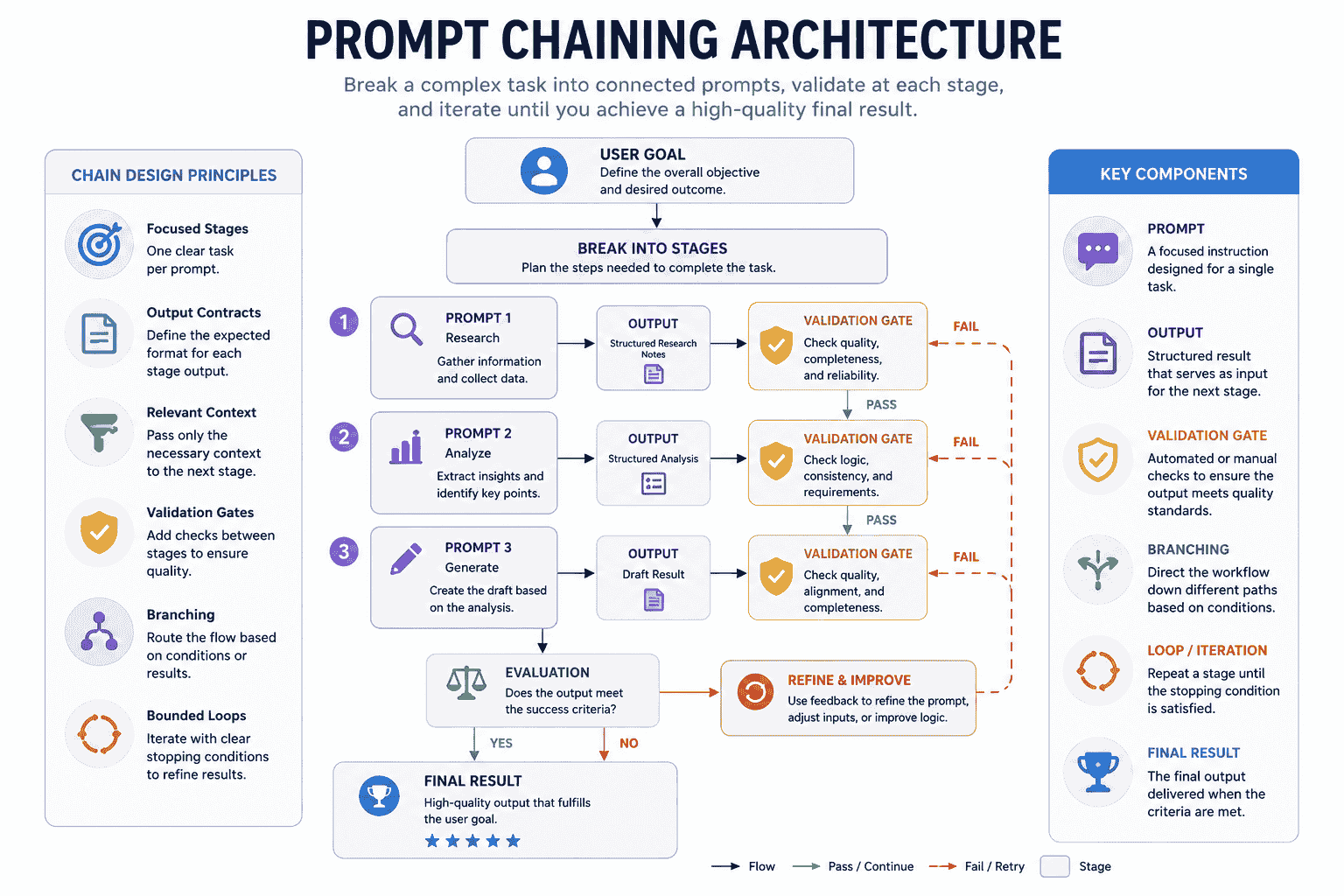
But a more useful production-style chain often looks like:
User Goal
   ↓
Prompt 1: Gather / transform information
   ↓
Structured Output
   ↓
Validation
   ↓
Prompt 2: Analyze
   ↓
Structured Decision
   ↓
Prompt 3: Generate
   ↓
Evaluation
   ↓
Final Result
The prompts do not need to be identical in structure. One stage may classify, another may extract JSON, another may write prose, and another may evaluate the result.
Why Use Prompt Chaining?
One Prompt Can Accumulate Too Many Responsibilities
Consider this instruction:
Research the market, identify competitors, compare their positioning,
find opportunities, create a product strategy, write launch messaging,
review everything for factual accuracy, improve the copy, and return
the final launch plan.
The model is being asked to research, extract, compare, reason, plan, write, verify, and edit in one pass.
That can work for lightweight tasks, but it creates several problems when the task becomes important:
- It is harder to see which stage failed.
- Early mistakes can influence every later section.
- The prompt becomes difficult to maintain.
- One output format must somehow serve many different stages.
- You cannot easily retry only the weak stage.
- Evaluation happens too late if it is performed only on the final result.
Focused Stages Are Easier to Diagnose
Stage 1: Research competitors
Stage 2: Extract comparable facts
Stage 3: Verify important claims
Stage 4: Analyze positioning
Stage 5: Identify opportunities
Stage 6: Draft strategy
Stage 7: Evaluate against requirements
Stage 8: Refine final output
If Stage 3 fails, you know the evidence pipeline is the problem. If Stage 7 fails, you can refine the strategy without repeating the original research.
Intermediate Results Become Inspectable
Raw Sources
   ↓
Research Notes
   ↓
Verified Claims
   ↓
Analysis
   ↓
Draft
   ↓
Evaluation
   ↓
Final
This is useful whenever the intermediate artifact itself matters.
Different Stages Can Use Different Instructions
A research step may prioritize evidence and uncertainty. A synthesis step may prioritize structure. A writing step may prioritize audience and tone. A verification step may ignore style completely and focus only on correctness.
Separating stages prevents those goals from competing inside one oversized instruction.
How Prompt Chaining Works
A reliable chain usually contains five kinds of components:
- Input: the information entering the stage.
- Focused prompt: one clear transformation or decision.
- Output contract: the expected structure of the result.
- Validation: a rule that decides whether the result can continue.
- Next-stage mapping: the subset of output passed forward.
INPUT
  ↓
FOCUSED PROMPT
  ↓
OUTPUT CONTRACT
  ↓
VALIDATION
  ↓
TRANSFORM / SELECT CONTEXT
  ↓
NEXT PROMPT
This is the difference between merely asking several prompts and intentionally designing a chain.
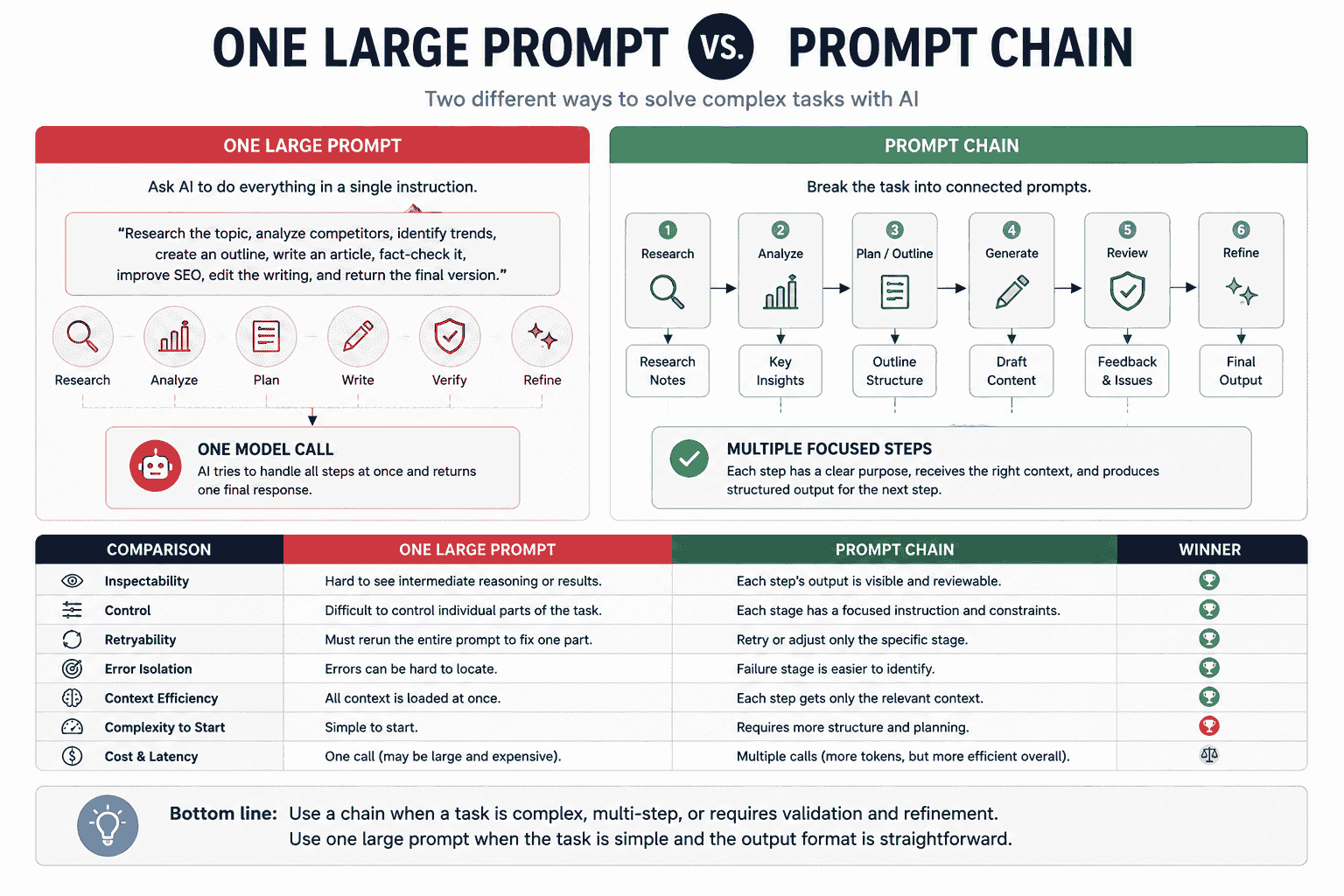
One Large Prompt vs. Prompt Chain
| Dimension | One Large Prompt | Prompt Chain |
|---|---|---|
| Setup | Simple | More structured |
| Model calls | Usually fewer | Usually more |
| Latency | Often lower | Can increase because steps are sequential |
| Debugging | Harder to isolate failures | Failure stage is easier to identify |
| Intermediate inspection | Limited | Built into the workflow |
| Retryability | Often rerun the whole task | Retry one stage when architecture allows |
| Validation | Often concentrated at the end | Can happen between stages |
| Context control | One prompt may contain everything | Each stage can receive only relevant context |
| Maintenance | Easy while simple | Better separation as complexity grows |
| Error propagation | Can be difficult to trace | Can be stopped at stage boundaries |
Prompt chaining is not automatically better. Sequential calls create additional latency and cost. If the task can be solved reliably with one focused prompt, keep it simple.
When to Use Prompt Chaining
Prompt chaining is a strong fit when:
- A task naturally has sequential stages.
- The output of one step is required by the next.
- Intermediate artifacts need to be reviewed or stored.
- Different stages have different success criteria.
- Validation should happen before generation continues.
- You need to rerun one stage without repeating everything.
- One prompt is becoming difficult to understand or maintain.
- Context can be reduced by passing only relevant intermediate results.
- A reusable workflow should produce the same sequence of transformations each time.
Common use cases include document processing, structured research, content refinement, code generation workflows, data extraction, multi-stage analysis, and quality-controlled generation. AWS specifically lists document review, code generation, knowledge extraction, and content refinement as prompt-chaining use cases.
When Not to Use Prompt Chaining
A prompt chain adds orchestration. Do not add it when the orchestration has no clear value.
- Simple tasks: one focused prompt may be enough.
- Independent subtasks: consider parallelization instead of forcing them into a sequence.
- Highly dynamic tasks: an agent may be more appropriate when the next step cannot be predefined.
- Low-latency interactions: multiple sequential model calls can become too slow.
- Tiny transformations: programmatic logic may be cheaper and more reliable than another LLM call.
- No useful stage boundary: splitting a coherent task arbitrarily can make quality worse rather than better.
Anatomy of a Prompt Chain Stage
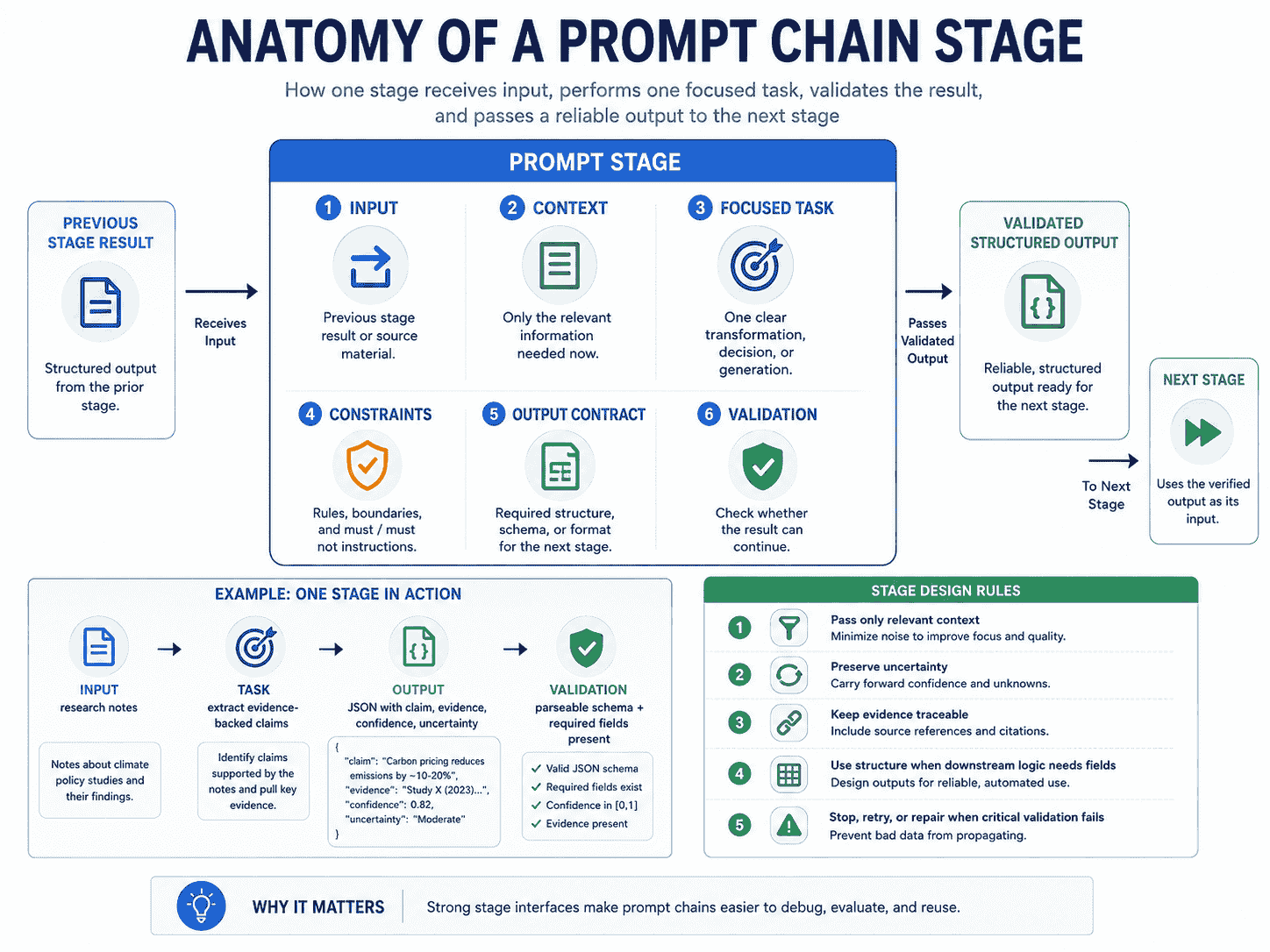
Each stage should have a clear contract.
PROMPT STAGE

INPUT
What information enters this stage?

CONTEXT
What previous information is actually needed?

TASK
What single transformation, decision, or generation should happen?

CONSTRAINTS
What must or must not happen?

OUTPUT CONTRACT
What exact structure should the next stage receive?

VALIDATION
How do we know this stage can continue?
Example Stage
INPUT:
{research_notes}

TASK:
Extract only evidence-backed claims relevant to {topic}.

CONSTRAINTS:
- Do not infer unsupported claims.
- Preserve uncertainty.
- Exclude duplicate claims.
- If evidence is insufficient, mark the claim as uncertain.

OUTPUT:
Return JSON:
{
  "claims": [
    {
      "claim": "...",
      "evidence": "...",
      "source": "...",
      "confidence": "high | medium | low",
      "uncertainty": "..."
    }
  ]
}
The next stage does not need the original research conversation if this structured output contains everything it needs.
Designing Intermediate Outputs
The quality of a prompt chain depends heavily on the interface between stages.
Consider this Stage 1 result:
The company looks promising. It seems to be growing and customers
appear to like the product, although there may be some concerns.
It may be readable, but it is a weak interface for the next stage. Important distinctions are mixed together and evidence is missing.
A more useful intermediate result might be:
{
  "growth_signals": [
    {
      "claim": "...",
      "evidence": "...",
      "confidence": "high"
    }
  ],
  "customer_signals": [
    {
      "claim": "...",
      "evidence": "...",
      "confidence": "medium"
    }
  ],
  "risks": [],
  "unknowns": []
}
Now the next prompt can reason over explicit fields instead of interpreting vague prose.
Good Intermediate Outputs Are:
- Focused on what the next stage needs.
- Structured when downstream logic depends on fields.
- Explicit about uncertainty.
- Free from unnecessary prose.
- Stable enough that the next prompt does not need to guess the format.
- Easy to validate.
Output Contracts
An output contract defines what one stage promises to return to the next.
Return:
- exactly one primary category,
- zero or more secondary categories,
- confidence from 0 to 1,
- evidence copied from the input,
- unresolved ambiguity.
Or use a schema:
{
  "primary_category": "billing",
  "secondary_categories": ["account"],
  "confidence": 0.87,
  "evidence": ["..."],
  "ambiguity": "..."
}
Output contracts help with reliable parsing, validation, downstream prompt clarity, testing, versioning, and error isolation.
Passing Context Between Prompts
A common implementation mistake is passing every previous prompt and response into every later stage.
Stage 1 context
      ↓
Stage 2 gets everything
      ↓
Stage 3 gets everything from 1 + 2
      ↓
Stage 4 gets everything from 1 + 2 + 3
      ↓
Context keeps growing
Instead, ask what the next step actually needs:
Current Instructions
+
Required Source Context
+
Relevant Structured Result From Previous Stage
If Stage 1 extracted verified facts from a long report and Stage 2 only needs those facts to produce an outline, do not automatically pass the entire report again.
This reduces noise, limits duplicated context, and makes each stage easier to reason about.
Sequential Prompt Chaining
The simplest prompt chain is linear.
A → B → C → DEach stage depends on the previous stage and the workflow follows a predefined order.
Example: Research to Article
Prompt 1
Research the topic
      ↓
Research Notes
      ↓
Prompt 2
Extract evidence-backed findings
      ↓
Structured Findings
      ↓
Prompt 3
Create an outline
      ↓
Outline
      ↓
Prompt 4
Write the article
      ↓
Draft
      ↓
Prompt 5
Evaluate against requirements
      ↓
Feedback
      ↓
Prompt 6
Refine
      ↓
Final Article
This pattern is useful when each step has a clear dependency. There is little value in drafting the article before the evidence and outline exist.
Keep Each Stage Narrow
A stage should not quietly absorb the responsibilities of the entire chain.
Weak Stage 2:
Analyze the research, decide the positioning, create the outline,
write the article, and make it SEO-friendly.
Better Stage 2:
Using only the verified research findings below, identify the three
most important themes for the article.

For each theme return:
- theme,
- supporting evidence,
- why it matters to the target reader,
- unresolved uncertainty.

Do not write the article yet.
The explicit “do not write the article yet” boundary can be useful because it keeps responsibilities separated.
Prompt Chaining With Validation Gates
Anthropic's prompt-chaining guidance notes that programmatic checks can be added between steps to make sure the process remains on track. This is one of the most useful improvements you can make to a chain.
Prompt Stage
     ↓
Intermediate Output
     ↓
Validation Gate
   ↙             ↘
PASS             FAIL
 ↓                ↓
Next Stage      Retry / Repair / Stop
Deterministic Validation
Use programmatic checks when the requirement can be measured exactly.
Examples:
- Is the output valid JSON?
- Are all required fields present?
- Is the category one of the allowed labels?
- Does generated code compile?
- Do required tests pass?
- Is the result below a maximum length?
- Are all IDs present in the known input set?
Semantic Validation
Some criteria require judgment:
- Does the analysis actually follow the evidence?
- Does the summary preserve the main argument?
- Is the proposed strategy relevant to the target audience?
- Does the output match a defined brand voice?
These may require a human reviewer, a rubric-based LLM judge, or another domain-specific evaluator.
Example: Extraction Gate
Stage 1:
Extract customer issues as JSON.

Validation:
- JSON parses
- each item contains issue, evidence, category
- category is in allowed list

If PASS:
Continue to theme analysis.

If FAIL:
Retry extraction with the validation error.
This is stronger than allowing malformed Stage 1 output to reach every downstream step.
Prompt Chaining With Routing and Branching
Basic prompt chaining is sequential. Once you introduce conditional branches, you are combining chaining with a routing pattern.
This distinction matters because not every branch should be described as pure prompt chaining.
Classify Request
       ↓
  Request Type?
   ┌───┼────┐
   ↓   ↓    ↓
Sales Support Billing
   ↓   ↓    ↓
Different downstream chains
AWS treats routing as its own workflow pattern: classify the input, then delegate it to the appropriate specialized path. Chaining and routing can still work together.
Example: Customer Request Workflow
Stage 1: Classify request

If billing:
  Stage 2B: Extract invoice/payment context
  Stage 3B: Draft billing response

If account:
  Stage 2A: Extract access/authentication issue
  Stage 3A: Draft account response

If product:
  Stage 2P: Identify feature and expected behavior
  Stage 3P: Draft product response
The routing stage should ideally return a stable label and confidence so the workflow can handle ambiguity explicitly.
Prompt Chaining With Evaluation and Revision Loops
A chain can also include feedback loops.
Generate Draft
      ↓
Evaluate
      ↓
Meets Criteria?
  ┌───┴───┐
 Yes      No
  ↓        ↓
Final    Feedback
           ↓
         Refine
           ↺
This combines prompt chaining with an evaluator-refine pattern. AWS documents evaluator and reflect-refine loops as related but distinct workflow patterns.
Always Bound the Loop
Do not use:
Keep improving until it is perfect.“Perfect” is undefined and the loop may continue without meaningful progress.
Use explicit stopping conditions:
Stop when any condition is met:
- overall score ≥ 90,
- all critical criteria pass,
- maximum 3 revisions,
- two consecutive revisions improve the score by less than 2 points.
Feed Specific Evaluation Results Back Into Refinement
Weak:
Make it better.Better:
Revise the draft using only the evaluation findings below.

Critical failures:
{critical_failures}

Scores below threshold:
{weak_criteria}

Requirements:
- Preserve sections that already passed.
- Fix the identified failures.
- Do not add unsupported claims.
- Return the revised draft only.
Preventing Cascading Errors
The biggest architectural risk in a prompt chain is that an early mistake becomes trusted context for every later stage.
Incorrect Research
       ↓
Incorrect Extraction
       ↓
Incorrect Analysis
       ↓
Polished Strategy
       ↓
Confident but Wrong Final Output
The final result can look excellent even when its foundation is wrong.
Add Validation Near the Source of the Risk
Research
   ↓
Evidence Check
   ↓
Extract
   ↓
Schema Check
   ↓
Analyze
   ↓
Reasoning / Requirement Check
   ↓
Generate
   ↓
Final Evaluation
Do not wait until the end to discover that Stage 1 invented a fact.
Preserve Provenance
If downstream stages make factual claims, preserve enough source information to trace them.
{
  "claim": "The API removed endpoint X.",
  "evidence": "Release notes state ...",
  "source": "...",
  "source_section": "...",
  "confidence": "high"
}
Preserve Uncertainty
A common failure is converting uncertain evidence into certainty as it moves through the chain.
Stage 1:
"This may indicate a pricing change."

Stage 2:
"The company changed pricing."

Stage 3:
"The pricing change created an opportunity."
The uncertainty disappeared.
Instead, make uncertainty part of the output contract so later stages cannot silently erase it.
Do Not Let a Later Stage Rewrite Evidence
When evidence matters, pass source-backed claims as immutable reference data and tell later stages to distinguish interpretation from evidence.
Prompt Chaining vs. Prompt Iteration
Prompt iteration and prompt chaining can look similar because both use multiple interactions, but they are not the same design pattern.
| Dimension | Prompt Iteration | Prompt Chaining |
|---|---|---|
| Flow | Often exploratory | Usually predefined |
| Next step | Human decides based on result | Workflow defines the next stage |
| Goal | Improve or explore one result | Complete a multi-stage task |
| Interfaces | Often conversational | Can use explicit output contracts |
| Reuse | May be ad hoc | Designed to be reusable |
Prompt Iteration
User: Write a product description.
AI: [draft]

User: Make it shorter.
AI: [revision]

User: Make the tone more technical.
AI: [revision]
Prompt Chaining
Stage 1: Extract product facts
Stage 2: Map facts to audience benefits
Stage 3: Draft description
Stage 4: Validate prohibited claims
Stage 5: Refine tone
Iteration is often human-driven refinement. Chaining is workflow design.
Prompt Chaining vs. Prompt Engineering
Prompt engineering is the broader discipline of designing instructions and context so an AI system produces useful behavior.
Prompt chaining is one technique inside that broader discipline.
Prompt Engineering
    │
    ├── Clear instructions
    ├── Context
    ├── Examples
    ├── Constraints
    ├── Structured output
    ├── Prompt evaluation
    └── Prompt chaining
A useful distinction is:
Prompt engineering asks how to design an effective instruction. Prompt chaining asks how multiple instructions should work together as a workflow.
Prompt Chaining vs. Parallelization
Do not turn independent work into a sequential chain simply because chaining is available.
Sequential Dependency
Extract
  ↓
Analyze
  ↓
Generate
Prompt chaining is appropriate because each stage depends on the previous one.
Independent Work
             Input
      ┌────────┼────────┐
      ↓        ↓        ↓
  Review A  Review B  Review C
      └────────┼────────┘
               ↓
           Aggregate
This is parallelization, not a simple chain.
Google's guidance explicitly separates chain prompts, where subtasks run sequentially, from aggregating responses, where independent subtasks run in parallel. AWS also documents parallelization as a separate workflow pattern.
Hybrid Workflows
Real systems often combine both:
Discover Targets
       ↓
Parallel Reviews
       ↓
Aggregate Findings
       ↓
Sequential Verification
       ↓
Final Synthesis
The goal is not to label everything a chain. The goal is to choose the structure that matches the dependencies.
Prompt Chaining vs. AI Agents
Prompt chains use a more predefined workflow. Agents have greater autonomy to decide what to do next.
| Dimension | Prompt Chain | AI Agent |
|---|---|---|
| Next step | Mostly defined by workflow | Model can decide dynamically |
| Control | Higher predictability | Higher autonomy |
| Best fit | Known multi-stage process | Open-ended task requiring dynamic decisions |
| Debugging | Stage-oriented | May require tracing decisions and tool calls |
| Complexity | Usually lower | Usually higher |
Anthropic's architecture guidance distinguishes workflows, where LLMs and tools follow predefined code paths, from agents, where the model dynamically directs its own process and tool usage.
Use a chain when you already know the useful sequence. Use an agent when deciding the sequence is itself part of the task.
Prompt Chaining vs. Dynamic Workflows
Prompt chaining is a general workflow pattern. A platform-specific orchestration system can implement much richer control around that pattern.
For example, Claude Code Dynamic Workflows use JavaScript to orchestrate subagents, variables, branching, loops, verification, and background execution. That is much broader than simply passing one prompt result to the next.
| Prompt Chaining | Dynamic Workflow |
|---|---|
| Connected LLM steps | Programmatic orchestration |
| Often sequential | Sequential + parallel + branch + loop |
| Can be implemented manually or in code | Explicit runtime/orchestration system |
| General prompting pattern | Platform-specific workflow capability |
If you want the deeper code-controlled orchestration pattern, see Claude Code Dynamic Workflows and Ultracode.
How to Evaluate a Prompt Chain
A chain should be evaluated at two levels:
- Stage-level evaluation: Does each individual prompt do its job?
- End-to-end evaluation: Does the complete chain produce the required final outcome?
Why Both Matter
A chain can produce a good final answer despite a weak intermediate step, or each stage can look individually reasonable while their combined behavior fails.
Track both.
Example Scorecard
| Stage | Primary Metric | Critical Failure |
|---|---|---|
| Research | Source coverage | Unsupported factual claim |
| Extraction | Field accuracy | Invalid schema |
| Analysis | Evidence alignment | Conclusion contradicts evidence |
| Generation | Requirement coverage | Missing required section |
| Final | Overall usefulness | Critical factual error |
Evaluate Error Propagation
When Stage 1 is slightly wrong, how badly does that affect Stage 5?
Good workflow design should limit propagation through validation, uncertainty fields, and stage-specific checks.
Evaluate Cost and Latency
A six-stage chain may improve quality but take several times as long as one model call. Compare the quality improvement with:
- number of model calls,
- input and output tokens,
- end-to-end latency,
- retry rate,
- failure rate,
- and operational complexity.
For a full evaluation framework, see AI Prompt Evaluation: How to Test, Compare, and Improve Prompts.
Prompt Chaining Examples
The following examples show how the same architecture can be adapted to different tasks. The goal is not to maximize the number of stages. Use only stages that create a useful boundary, transformation, or validation point.
Example 1: Research → Outline → Article
Stage 1: Research
Collect evidence and preserve sources.

Stage 2: Extract
Return only claims relevant to the article angle.

Stage 3: Outline
Turn verified findings into a logical structure.

Stage 4: Draft
Write from the outline and evidence.

Stage 5: Evaluate
Check factual consistency, completeness, audience fit, and structure.

Stage 6: Refine
Fix only failed criteria.
This is useful when you do not want drafting to begin before the evidence and structure are stable.
Example 2: Article → Multi-Platform Social Content
Article
   ↓
Extract Core Ideas
   ↓
Identify Platform-Specific Angles
   ↓
LinkedIn Draft
   ↓
X Draft
   ↓
Carousel Outline
   ↓
Final Brand/Tone Check
The extraction step prevents every social prompt from independently interpreting the long article.
Example 3: Competitor Research → Differentiation → Messaging
Stage 1:
Extract comparable competitor facts.

Stage 2:
Normalize features, pricing, positioning, and target users.

Stage 3:
Identify verified similarities and differences.

Stage 4:
Generate differentiation opportunities.

Stage 5:
Draft messaging using only supported differences.

Stage 6:
Check for unsupported competitor claims.
Separating facts from positioning is especially important because marketing language can otherwise turn uncertain differences into confident claims.
Example 4: Audience Research → Positioning → Campaign
Audience Inputs
   ↓
Pain-Point Extraction
   ↓
Priority / Frequency Analysis
   ↓
Positioning Options
   ↓
Message Evaluation
   ↓
Campaign Concepts
The positioning stage can return several options with evidence, allowing the campaign stage to use a selected direction instead of generating positioning and execution simultaneously.
Example 5: Customer Feedback → Themes → Product Actions
Feedback
   ↓
Normalize and Deduplicate
   ↓
Classify
   ↓
Cluster Themes
   ↓
Estimate Evidence Strength
   ↓
Recommend Product Actions
   ↓
Human Review
Do not let the final recommendation stage treat one isolated complaint as a major product trend. Preserve counts, evidence, and uncertainty through the chain.
Example 6: Meeting Transcript → Decisions → Tasks → Follow-Up
Transcript
   ↓
Extract Decisions
   ↓
Extract Action Items
   ↓
Validate Owner / Deadline Evidence
   ↓
Generate Task Summary
   ↓
Draft Follow-Up Email
If an owner or deadline was not explicitly stated, the extraction stage should mark it unknown instead of inventing one for the email.
Example 7: Document → Structured Data → Analysis
Document
   ↓
Extract Required Fields
   ↓
Schema Validation
   ↓
Normalize Values
   ↓
Analyze
   ↓
Generate Report
This is often stronger than asking the model to extract and analyze in the same step, because extraction accuracy can be validated independently.
Example 8: Research → Verify → Synthesize
Stage 1:
Collect candidate sources.

Stage 2:
Extract claims and evidence.

Stage 3:
Cross-check important claims.

Stage 4:
Remove or label unsupported claims.

Stage 5:
Synthesize the verified evidence.

Stage 6:
Check citation coverage.
This chain prioritizes evidence integrity over producing the final prose as quickly as possible.
Example 9: Requirements → Implementation Plan → Code → Review
Requirements
   ↓
Clarify Acceptance Criteria
   ↓
Implementation Plan
   ↓
Code Generation
   ↓
Tests / Static Checks
   ↓
Code Review
   ↓
Fix Confirmed Issues
When possible, use executable tests as validation rather than adding another LLM call for conditions that code can verify exactly.
Example 10: Bug Report → Hypotheses → Verification → Fix Plan
Bug Report
   ↓
Extract Observed Symptoms
   ↓
Generate Candidate Causes
   ↓
Verify Candidates Against Evidence
   ↓
Rank Supported Causes
   ↓
Create Fix Plan
   ↓
Verification Plan
The chain should prevent an early hypothesis from being treated as the root cause before evidence exists.
Example 11: Support Request → Classification → Context → Response
Request
   ↓
Classify Intent
   ↓
Retrieve Relevant Policy / Context
   ↓
Extract Applicable Rules
   ↓
Draft Response
   ↓
Policy Check
This is a hybrid workflow because the classification step may route the request into different downstream chains.
Example 12: Product Facts → Benefits → Sales Copy
Product Data
   ↓
Extract Verified Capabilities
   ↓
Map Capabilities to User Benefits
   ↓
Select Audience-Relevant Benefits
   ↓
Draft Copy
   ↓
Unsupported-Claim Check
This makes it harder for the copywriting stage to invent product capabilities just because they would sound persuasive.
Example 13: Idea → Creative Brief → Image Prompt → Evaluation
Creative Idea
   ↓
Creative Brief
   ↓
Visual Requirements
   ↓
Image Prompt
   ↓
Generate Image
   ↓
Evaluate Against Brief
   ↓
Refine Prompt
The creative brief acts as a stable specification, while the image prompt becomes one implementation of that specification.
Example 14: Long Report → Executive Summary → Decision Brief
Long Report
   ↓
Section-Level Extraction
   ↓
Important Findings
   ↓
Risk / Opportunity Classification
   ↓
Executive Summary
   ↓
Decision Brief
The executive summary and decision brief have different goals. Keeping them separate prevents decision recommendations from being mixed into factual summarization.
Example 15: Data Quality Review → Analysis → Recommendation
Dataset Description
   ↓
Identify Data Quality Risks
   ↓
Validate Against Available Metadata
   ↓
Select Reliable Variables
   ↓
Perform Analysis
   ↓
Generate Recommendations
   ↓
Limitations Check
The limitations stage should preserve what the analysis cannot support, not merely improve the writing.
Example 16: Localization Workflow
Source Copy
   ↓
Extract Meaning / Constraints
   ↓
Translate
   ↓
Localize Tone and Idioms
   ↓
Terminology Check
   ↓
Back-Check Critical Meaning
   ↓
Final Localized Copy
Translation and localization are related but different transformations. Separating them can make terminology and tone easier to evaluate.
Example 17: Resume → Role Requirements → Tailored Application
Job Description
   ↓
Extract Requirements
   ↓
Resume
   ↓
Map Evidence to Requirements
   ↓
Identify Gaps
   ↓
Draft Tailored Resume / Cover Letter
   ↓
Unsupported-Claim Check
The evidence mapping stage should explicitly prevent the writing stage from inventing experience that is not present in the source resume.
Example 18: Product Review Dataset → Buying Guide
Reviews / Specs
   ↓
Normalize Product Facts
   ↓
Extract Repeated Pros / Cons
   ↓
Separate Objective vs Subjective Signals
   ↓
Segment by Buyer Type
   ↓
Generate Recommendations
   ↓
Evidence Check
This chain separates evidence collection from recommendation, which reduces the risk of a polished buying guide being based on one anecdotal review.
Reusable Prompt Chain Templates
Template 1: Extract → Validate → Transform
STAGE 1 — EXTRACT

Input:
{source}

Task:
Extract only the information needed for {goal}.

Output:
{schema}

Do not analyze or recommend yet.


VALIDATION

Check:
- output parses,
- required fields are present,
- values are supported by source evidence.


STAGE 2 — TRANSFORM

Input:
{validated_stage_1_output}

Task:
Transform the extracted information into {target_result}.

Constraints:
{constraints}

Output:
{target_format}
Template 2: Research → Verify → Synthesize
STAGE 1 — RESEARCH
Collect candidate evidence for {question}.
Preserve source and uncertainty.

STAGE 2 — VERIFY
Review each important claim.
Return:
- supported,
- contradicted,
- insufficient evidence.

STAGE 3 — SYNTHESIZE
Use only supported evidence.
Clearly label remaining uncertainty.
Return the answer in {format}.
Template 3: Generate → Evaluate → Refine
STAGE 1 — GENERATE
Create {artifact} using {requirements}.

STAGE 2 — EVALUATE
Score the artifact against:
{rubric}

Return:
- passing criteria,
- failing criteria,
- evidence,
- critical failures.

STAGE 3 — REFINE
Fix only the failing criteria.
Preserve content that already passes.
Return the revised artifact.

STOP when:
- all critical criteria pass, or
- maximum {n} revisions are reached.
Template 4: Classify → Route → Complete
STAGE 1 — CLASSIFY
Return one of:
{allowed_routes}

Also return:
- confidence,
- evidence,
- ambiguity.

ROUTING RULE
If confidence < {threshold}, request clarification or send to fallback.

STAGE 2 — SPECIALIZED PATH
Use the prompt associated with the selected route.

STAGE 3 — FINAL VALIDATION
Check the result against the route-specific requirements.
Template 5: Plan → Execute → Verify
STAGE 1 — PLAN
Create a bounded plan for {task}.
Do not execute yet.

STAGE 2 — PLAN CHECK
Validate dependencies, constraints, and acceptance criteria.

STAGE 3 — EXECUTE
Complete the approved plan.

STAGE 4 — VERIFY
Evaluate the result against the original acceptance criteria.

STAGE 5 — CORRECT
Fix only confirmed failures, then verify again.
Common Prompt Chaining Mistakes
1. Splitting a Simple Task Into Too Many Steps
Every model call adds latency, cost, and another possible failure point. Use a chain only when the stage boundary creates real value.
2. Creating Stages Without Clear Responsibilities
If Stage 1 analyzes while Stage 2 re-analyzes the same material and Stage 3 does it again, the chain is redundant.
3. Passing Unstructured Prose Between Machine-Like Stages
If the next stage needs specific fields, give it structured output rather than making it rediscover the fields from a paragraph.
4. Passing the Entire History Everywhere
More context is not always better context. Pass only what the current stage needs.
5. Trusting Early Outputs Automatically
An error in Stage 1 can become the premise of every later stage. Add validation where failure would propagate.
6. Validating Only the Final Output
Final evaluation is important, but it may be too late to discover that a source extraction step failed several stages earlier.
7. Using LLM Validation for Deterministic Requirements
If you can parse the JSON, run the test, check the label, or verify the schema in code, prefer that over another subjective model call.
8. Removing Uncertainty Between Stages
Preserve confidence, missing evidence, ambiguity, and unresolved questions when downstream decisions depend on them.
9. Using Sequential Calls for Independent Tasks
If several subtasks do not depend on each other, parallelization may be faster and structurally cleaner.
10. Adding Branches Without a Stable Routing Contract
Use explicit labels, confidence, and fallback behavior. Do not route based on loosely formatted prose.
11. Creating Unbounded Revision Loops
Set maximum rounds, pass thresholds, and no-progress rules.
12. Letting Every Stage Rewrite the Source of Truth
Evidence and source data should be preserved separately from interpretation.
13. Evaluating Stages but Not the Whole Chain
Good components do not guarantee a good system. Test end-to-end behavior as well.
14. Optimizing for Quality Without Measuring Latency or Cost
A chain that improves quality by 2% but multiplies latency and token usage may not be a good tradeoff for the application.
15. Confusing Prompt Chaining With Agent Autonomy
A predefined multi-step workflow is not automatically an agent. Use the terminology that reflects who decides the next action.
Building Better Prompt Chains With PrompTessor
Prompt chaining is a workflow pattern. PrompTessor is not an orchestration engine that automatically runs an entire multi-step application workflow.
Where PrompTessor can help is at the prompt-design layer of the chain.
A rough workflow idea might start as:
Research my competitors, analyze them, and create a launch strategy.
Before turning that into one large prompt, break it into stages:
Stage 1
Competitor research

Stage 2
Evidence extraction

Stage 3
Positioning analysis

Stage 4
Strategy generation

Stage 5
Strategy evaluation
Each stage now needs a prompt with its own goal, context, constraints, and output contract.
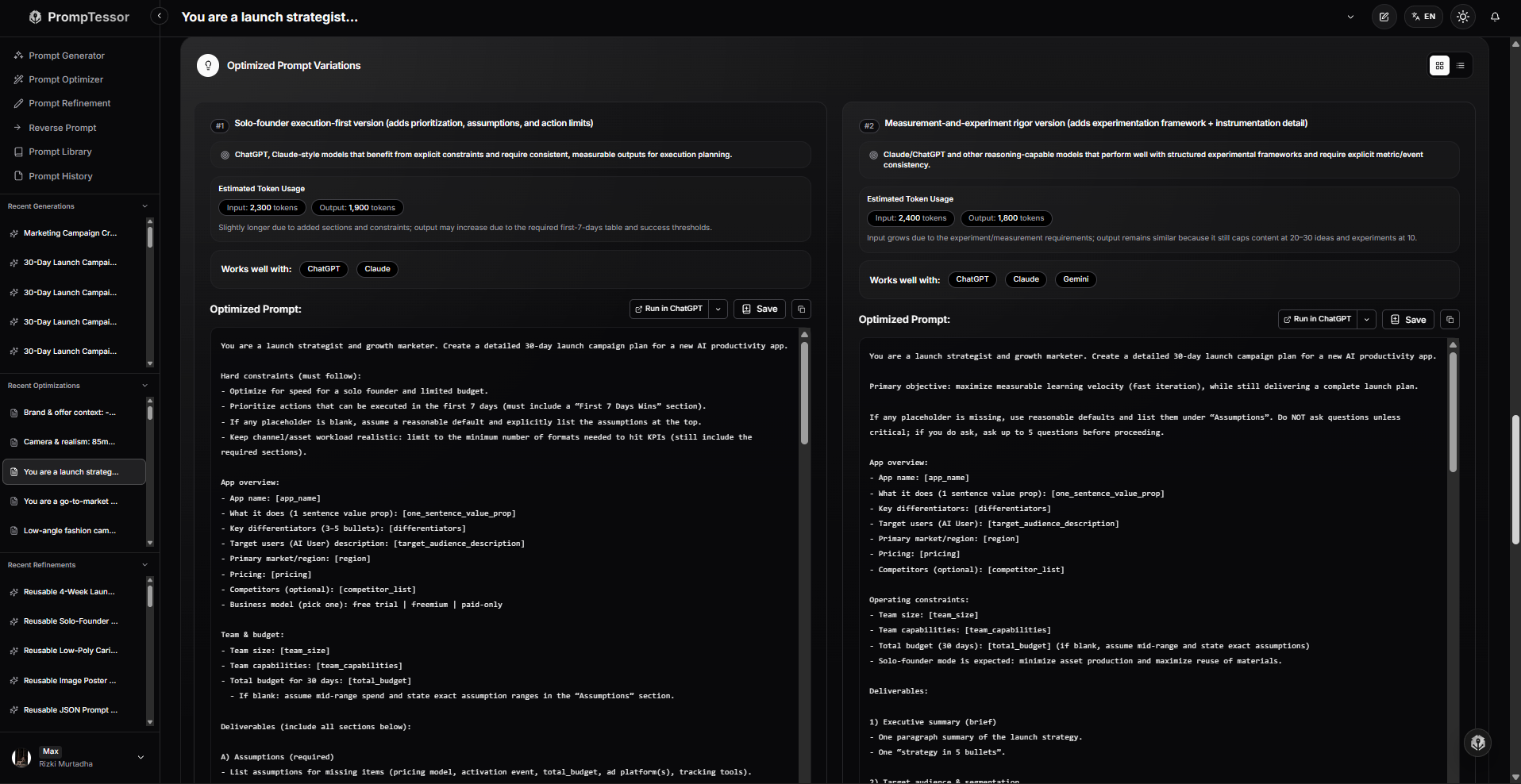
PrompTessor can support this process by helping you:
- generate a focused prompt for an individual stage,
- analyze the prompt for clarity, specificity, context, goals, structure, and constraints,
- optimize weak stage instructions,
- refine a prompt using feedback from evaluation results,
- save reusable stage prompts in your prompt library,
- and reuse or adapt prompt patterns across different AI tools.
Example Workflow
Rough Goal
   ↓
Break Into Stages
   ↓
Stage 1 Prompt
   ↓
PrompTessor Generate / Analyze / Optimize
   ↓
Stage 2 Prompt
   ↓
PrompTessor Generate / Analyze / Optimize
   ↓
Stage 3 Prompt
   ↓
PrompTessor Generate / Analyze / Optimize
   ↓
Connect Stages
   ↓
Evaluate End-to-End Chain
The important distinction is that improving individual prompts does not remove the need to evaluate the complete chain. A stage can be well-written and still create poor system-level behavior when combined with other stages.
For the evaluation side of this process, see AI Prompt Evaluation: How to Test, Compare, and Improve Prompts.
Prompt Chaining Checklist
- The task is complex enough to benefit from multiple stages.
- Each stage has one primary responsibility.
- Sequential stages have a real dependency.
- Independent tasks are parallelized when appropriate.
- Every stage has a defined input.
- Every stage has a defined output contract.
- Structured output is used when downstream logic depends on fields.
- Important uncertainty is preserved.
- Evidence is kept separate from interpretation.
- Only relevant context is passed forward.
- High-risk intermediate outputs have validation gates.
- Deterministic requirements use deterministic checks where possible.
- Routing stages use stable labels and fallback behavior.
- Revision loops have explicit stopping conditions.
- Failed stages can be retried or stopped safely.
- Stage-level quality is evaluated.
- End-to-end quality is evaluated.
- Cascading-error behavior is tested.
- Latency and token usage are measured when relevant.
- The chain is simpler than the problem it is trying to solve.
Official Resources
- Anthropic: Building Effective AI Agents
- Anthropic: Prompt Engineering for Business Performance
- AWS Prescriptive Guidance: Workflow for Prompt Chaining
- AWS Prescriptive Guidance: Workflow for Parallelization
- AWS Prescriptive Guidance: Workflow for Routing
- Google Cloud: Break Down Complex Tasks Into Simpler Prompts
FAQ About Prompt Chaining
What is prompt chaining?
Prompt chaining is a technique for splitting a complex task into multiple connected LLM calls, where each stage performs a focused task and passes its result or relevant context to a later stage.
Why is prompt chaining useful?
Prompt chaining can make complex workflows easier to inspect, debug, validate, retry, and maintain because each stage has a narrower responsibility.
Is prompt chaining better than one large prompt?
Not always. A single prompt is often simpler and faster for straightforward tasks. Prompt chaining becomes useful when the task has meaningful sequential stages, intermediate outputs matter, or validation between stages reduces risk.
What is a prompt chain example?
A common example is research → evidence extraction → analysis → outline → draft → evaluation → refinement. Each step consumes the result of an earlier stage and performs one focused transformation.
How many prompts should a prompt chain have?
There is no universal number. Use the fewest stages that create useful boundaries. A two-stage chain may be enough, while a high-value research or document-processing workflow may justify several validated stages.
Does every prompt chain need structured JSON output?
No. Structured output is most useful when downstream logic needs predictable fields, automated validation, routing, or parsing. Natural-language intermediate results can be appropriate when the next stage primarily performs qualitative interpretation.
What is an output contract in prompt chaining?
An output contract defines the structure and information one stage must return to the next. It can specify required fields, format, uncertainty, evidence, allowed labels, or validation rules.
Should every stage receive the entire conversation history?
No. Each stage should usually receive only the instructions, source context, and intermediate results it actually needs. Passing everything forward can increase noise, tokens, and context complexity.
What is a validation gate?
A validation gate checks whether an intermediate output is acceptable before the workflow continues. It can be deterministic, such as JSON parsing or tests, or qualitative, such as rubric-based review.
How do you prevent cascading errors in a prompt chain?
Validate high-risk intermediate outputs, preserve source evidence and uncertainty, use structured contracts, and stop or retry a stage when critical requirements fail instead of allowing weak results to propagate.
What is the difference between prompt chaining and prompt iteration?
Prompt iteration is often an exploratory human-driven process of revising a result through follow-up prompts. Prompt chaining is typically a predefined sequence of stages designed to complete a larger workflow.
What is the difference between prompt chaining and prompt engineering?
Prompt engineering is the broader practice of designing instructions, context, examples, and constraints for AI systems. Prompt chaining is one workflow technique within prompt engineering.
What is the difference between prompt chaining and parallelization?
Prompt chaining is appropriate when later tasks depend on earlier outputs. Parallelization is better when subtasks are independent and can run at the same time before their results are combined.
Can a workflow use both prompt chaining and parallelization?
Yes. A hybrid workflow might discover targets, process independent targets in parallel, aggregate the results, and then continue through sequential verification and synthesis stages.
What is the difference between prompt chaining and routing?
Prompt chaining follows a sequence of connected steps. Routing first classifies an input or condition and then selects one of several downstream paths. Routing can be combined with prompt chains.
Is prompt chaining the same as an AI agent?
No. A prompt chain generally follows a predefined workflow. An AI agent has more autonomy to decide which action or tool to use next based on the current state of the task.
When should I use an agent instead of a prompt chain?
Use an agent when the useful next step cannot be predefined and the model needs to make dynamic decisions. Use a prompt chain when the task already has a known and repeatable sequence.
Can prompt chaining include loops?
Yes, but once evaluation and revision loops are added, the system combines prompt chaining with broader evaluator-refine workflow patterns. Loops should have explicit pass thresholds, maximum rounds, or no-progress stopping conditions.
Can prompt chaining include branching?
Yes. A chain can be combined with routing so a classification or validation stage selects different downstream prompts. Use stable labels, confidence, and fallback behavior.
How should I evaluate a prompt chain?
Evaluate both individual stages and the complete end-to-end workflow. Track stage-specific accuracy or compliance, final outcome quality, critical failures, error propagation, consistency, latency, and cost where relevant.
Can one weak stage ruin the whole prompt chain?
Yes. An early unsupported claim or extraction error can become trusted input for every later stage. This is why validation and evidence preservation are important at high-risk boundaries.
Does prompt chaining increase latency?
Usually, yes, when calls are sequential. Each additional dependent LLM call adds execution time, so prompt chaining should provide enough control or quality benefit to justify the overhead.
Does prompt chaining cost more?
It can. Multiple model calls and repeated context can increase token usage. Good context selection, smaller intermediate outputs, deterministic checks, and avoiding unnecessary stages can reduce overhead.
What tasks are good for prompt chaining?
Good examples include document review, research and synthesis, content refinement, structured extraction, multi-stage analysis, code generation with validation, customer-support workflows, and creative brief-to-output processes.
What tasks are bad for prompt chaining?
Very simple tasks, extremely latency-sensitive interactions, independent subtasks that should run in parallel, and open-ended tasks requiring dynamic autonomous planning may be poor fits for a simple sequential chain.
Should I validate every stage?
Not necessarily. Add validation where failure is likely, costly, difficult to detect later, or capable of corrupting downstream stages. Over-validating low-risk steps can add unnecessary cost and latency.
Can deterministic code be part of a prompt chain?
Yes. In many useful workflows, LLM calls are combined with ordinary code for parsing, schema validation, calculations, tests, routing, filtering, retries, and persistence.
Can different models be used at different stages?
Yes. A workflow can use different models when their strengths, cost, latency, or context capabilities fit different stages. If you do this, evaluate the whole chain because model changes can affect the interface between stages.
What is the biggest prompt chaining mistake?
One of the biggest mistakes is splitting a task into multiple calls without designing the interfaces between them. A chain is only as reliable as the information, structure, validation, and uncertainty passed from one stage to the next.
How can PrompTessor help with prompt chaining?
PrompTessor can help generate, analyze, optimize, refine, save, and reuse the individual prompts used in a chain. The orchestration and end-to-end workflow still need to be implemented and evaluated separately.
Conclusion
Prompt chaining is not about turning every AI task into a complicated pipeline.
It is about recognizing when one instruction is doing too many different jobs and replacing that ambiguity with focused stages.
A strong prompt chain defines what each stage receives, what it must do, what it must return, how its output will be validated, and what information the next stage actually needs.
The most important design principle is the interface between stages.
Good prompts connected by vague intermediate outputs can still create a weak workflow. Clear output contracts, evidence preservation, uncertainty, validation gates, and bounded retries make the chain easier to trust and maintain.
Use one prompt when one prompt is enough. Use sequential chaining when tasks have real dependencies. Use parallelization when work is independent. Add routing when different inputs need different paths. Add evaluator-refine loops when revision is useful. Use agents when the system needs autonomy to decide what happens next.
Then evaluate the individual stages and the entire workflow.
Prompt engineering improves the instructions. Prompt chaining organizes how those instructions work together. Prompt evaluation tells you whether the resulting system actually performs better.
Build better prompts in one workspace
Generate prompts from ideas, analyze and optimize quality, refine with feedback, reverse-engineer content, and save reusable prompts in your Prompt Library.
Try PrompTessor Free