AI Prompt Evaluation: How to Test, Compare, and Improve Prompts
A prompt can look clear, detailed, and well structured and still perform poorly on real inputs. Another prompt can look surprisingly simple and consistently produce better results. That is why prompt quality should not be judged by wording alone.
AI prompt evaluation is the process of testing whether a prompt actually produces outputs that meet defined requirements. Instead of asking only, “Is this a good prompt?”, evaluation asks a more useful question: “Does this prompt reliably produce the result I need?”
In this guide, you will learn how to define success criteria, build representative test cases, run repeated trials, score model outputs, compare prompt variants, use human and model-based graders, test prompts across different AI models, detect regressions, and improve prompts through an evidence-based optimization loop.
Quick Answer
AI prompt evaluation means testing a prompt against representative inputs and measuring whether the resulting outputs meet predefined success criteria. A practical evaluation workflow usually includes a test set, one or more prompt variants, repeated model runs when variability matters, grading rules or rubrics, and a comparison step that determines whether a prompt change actually improved performance.
A strong-looking prompt is not automatically a strong-performing prompt. The most reliable way to improve prompting is to combine prompt analysis, empirical evaluation, and iterative optimization.
Key Takeaways
- Define what “good” means before changing the prompt.
- Evaluate outputs, not just the wording of the prompt.
- Use test cases that represent normal inputs, difficult inputs, and edge cases.
- Run multiple trials when model variability can affect the conclusion.
- Use deterministic checks whenever the requirement can be measured exactly.
- Use rubrics for qualities such as relevance, completeness, tone, and instruction following.
- Human evaluation and LLM-as-a-judge are complementary, not interchangeable.
- Compare prompt variants on the same dataset and model configuration.
- Track a baseline so future prompt changes can be regression-tested.
- Evaluate the prompt on the model and workflow where it will actually be used.
- Include cost, latency, and consistency when they matter to the real use case.
- Use prompt optimization after evaluation identifies a measurable weakness.
Table of Contents
- What Is AI Prompt Evaluation?
- Prompt Analysis vs. Evaluation vs. Optimization
- Why Reading a Prompt Is Not Enough
- Define Success Before You Test
- Common Prompt Evaluation Dimensions
- Build Representative Test Cases
- Why Multiple Trials Matter
- Prompt Evaluation Methods
- How to Build a Prompt Evaluation Rubric
- How to A/B Test AI Prompts
- Evaluate Different Prompt Types Differently
- Testing Prompts Across Different AI Models
- Prompt Regression Testing
- Building a Prompt Evaluation Dataset
- Practical Prompt Evaluation Examples
- How to Use LLM-as-a-Judge Carefully
- Quality Is Not the Only Metric
- Common Prompt Evaluation Mistakes
- A Practical Prompt Evaluation Workflow
- Where PrompTessor Fits
- Prompt Evaluation Checklist
- Official Resources
- FAQ
What Is AI Prompt Evaluation?
AI prompt evaluation is a structured process for measuring how well a prompt performs on the task it is supposed to accomplish. The basic idea is simple:
- Give the model a prompt and a representative input.
- Collect the output.
- Grade the output against explicit criteria.
- Repeat across enough test cases to reveal patterns.
- Compare the results before and after changing the prompt.
Anthropic describes an evaluation as a test that gives an AI system an input and applies grading logic to the output. Its current guidance also recommends defining measurable success criteria before designing the evaluation. OpenAI similarly describes evals as a way to test outputs against style and content criteria specified by the developer.
That definition is broader than prompt writing. Evaluation is not primarily about whether instructions sound professional. It is about whether the behavior produced by those instructions is acceptable for the real task.
For a customer-support classifier, success might mean assigning the correct category. For a summarization prompt, it might mean preserving important facts while staying concise. For a coding prompt, success might mean passing tests. For an image prompt, success may require adherence to subject, composition, lighting, typography, and brand constraints.
Prompt Analysis vs. Evaluation vs. Optimization
These three activities are related, but they answer different questions.
| Process | Main Question | What It Examines | Typical Outcome |
|---|---|---|---|
| Prompt Analysis | What is strong or weak about the prompt itself? | Clarity, specificity, context, goals, structure, constraints | Diagnosis of prompt quality |
| Prompt Evaluation | How well does the prompt actually perform? | Outputs across representative test cases | Measured performance |
| Prompt Optimization | How can the prompt be improved? | Prompt wording, structure, instructions, examples, constraints | A stronger prompt variant |
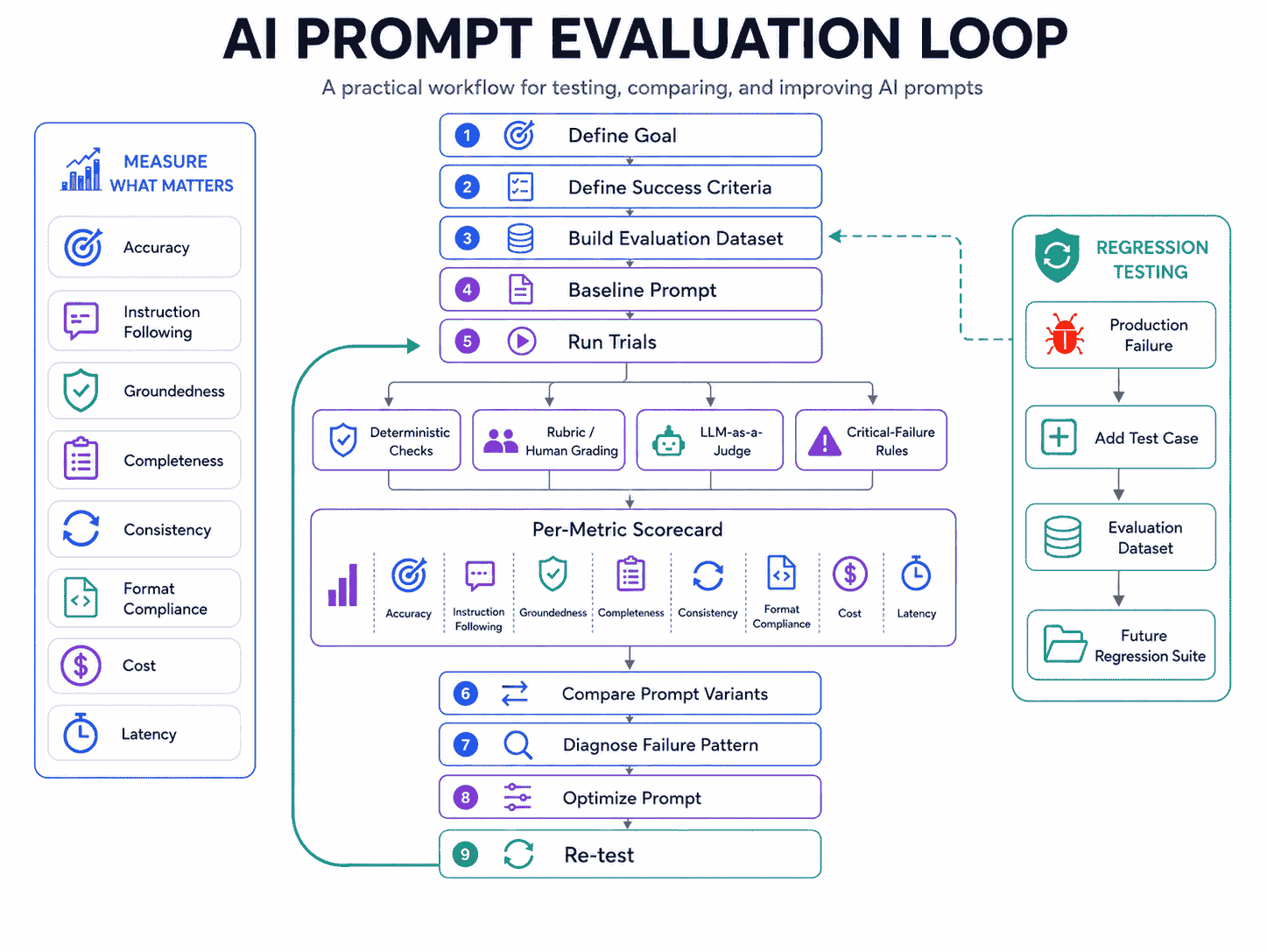
A useful workflow combines all three:
Prompt
  ↓
Analyze the prompt
  ↓
Identify likely weaknesses
  ↓
Evaluate on test cases
  ↓
Measure actual failures
  ↓
Optimize the prompt
  ↓
Evaluate again
  ↓
Keep, revise, or revert
Analysis can suggest why a prompt may fail. Evaluation tells you whether it actually fails. Optimization proposes a change. Re-evaluation tells you whether the change helped.
Why Reading a Prompt Is Not Enough
Consider these two prompts.
Prompt A
Summarize this article.Prompt B
Summarize the following article for a non-technical reader.

Requirements:
- Use no more than five bullet points.
- Preserve important numbers and dates.
- Include the main argument and supporting evidence.
- Do not add information that is not present in the source.
- If an important claim is uncertain in the source, preserve that uncertainty.
Prompt B is more explicit. It communicates audience, format, factual constraints, and completeness requirements. From prompt analysis alone, it is reasonable to predict that B will be easier for a model to follow.
But prediction is not proof.
You still do not know whether Prompt B:
- preserves facts more accurately across long documents,
- misses fewer important details,
- follows the five-bullet constraint consistently,
- works better on short and long inputs,
- performs better on the model you plan to use,
- increases latency or token usage enough to matter,
- or introduces a new failure mode that Prompt A did not have.
This is the central lesson of prompt evaluation: a prompt should be judged by its behavior on representative tasks, not by how impressive its wording looks.
Define Success Before You Test
The most important evaluation decision happens before you run the model: decide what success means.
Anthropic's current evaluation guidance recommends success criteria that are specific, measurable, achievable, and relevant. It also emphasizes that many real applications require multidimensional evaluation rather than a single score.
Bad Success Criterion
The answer should be good.Better Success Criteria
The answer must:
1. correctly identify the customer's requested cancellation,
2. not claim that a refund has already been issued,
3. explain the next required step,
4. use fewer than 120 words,
5. maintain the requested professional tone.
The second version gives you something you can grade. Some requirements are binary. Others can be scored on a scale.
Start With the User Outcome
Avoid choosing metrics only because they are easy to calculate. Start with what the user or workflow needs.
For example, a research assistant might require correctness, groundedness in supplied sources, citation coverage, clear separation between evidence and inference, and useful synthesis.
A marketing-writing prompt might instead prioritize message clarity, brand voice, audience fit, specificity, originality, and compliance with length or format constraints.
Common Prompt Evaluation Dimensions
There is no universal scorecard for every prompt. Choose dimensions that match the task. The following are common starting points.
| Dimension | Evaluation Question | Useful For |
|---|---|---|
| Instruction Following | Did the output follow the requested task and constraints? | Almost every prompt |
| Accuracy | Are factual or computational claims correct? | Research, support, analysis, code |
| Groundedness | Are claims supported by the provided source or context? | RAG, summarization, document QA |
| Completeness | Did the output cover all required information? | Summaries, reports, planning |
| Relevance | Does the output stay focused on the request? | Chat, research, content |
| Format Compliance | Does the response match the requested schema or structure? | JSON, tables, templates, automation |
| Consistency | Does performance remain stable across trials and inputs? | Production workflows |
| Tone and Style | Does the response match the intended voice and audience? | Writing, support, marketing |
| Safety | Does the output respect relevant safety requirements? | User-facing systems |
| Latency | Is response time acceptable? | Interactive applications |
| Cost | Is the quality gain worth the additional token or inference cost? | High-volume workflows |
Google's current data-driven prompt optimization documentation reflects this multidimensional approach: its optimizer can optimize against evaluation metrics such as summarization quality, question-answering correctness, coherence, safety, fluency, and groundedness, and it supports custom metrics for application-specific requirements.
Build Representative Test Cases
A prompt that succeeds on one convenient example has not been meaningfully evaluated. A useful test set should represent the range of inputs the prompt will actually receive.
Example: Customer-Support Classification
Suppose the prompt classifies messages into account, billing, product, or other.
Do not test only:
I forgot my password.Include a range such as:
| Case Type | Example | Why It Matters |
|---|---|---|
| Clear | I forgot my password. | Tests the basic path. |
| Ambiguous | I can't access my account. | Tests uncertainty. |
| Multiple Issues | I can't log in and I was charged twice. | Tests priority or multi-label behavior. |
| Informal | bro why cant i get into my acc | Tests robustness to writing style. |
| Long | A multi-paragraph complaint containing several details. | Tests attention and extraction. |
| Edge Case | Thanks, everything works now. | Tests whether the model invents an issue. |
Cover the Real Distribution
Anthropic recommends designing evals that mirror the real-world task distribution and explicitly including edge cases. That principle is more important than collecting a large random dataset that does not resemble production.
A practical test set often includes:
- normal cases that represent the most common input,
- difficult cases where the task requires more reasoning or interpretation,
- edge cases where instructions can break,
- adversarial or confusing cases when relevant,
- historical failures collected from real usage,
- high-value cases where mistakes are especially costly.
A Small Dataset Can Still Be Useful
You do not need thousands of test cases to stop relying on intuition. For an early prompt, a deliberately selected set such as 10 normal cases, 5 difficult cases, and 5 edge cases can already reveal failures that a single manual test would miss.
As the workflow becomes important, keep adding real failures and representative examples. Your evaluation set should mature with the product.
Why Multiple Trials Matter
Generative models can produce different outputs for the same input. A single run may therefore overstate or understate prompt quality.
Anthropic's 2026 guidance on agent evaluations distinguishes a task from a trial and recommends multiple trials when output variability matters. The same idea applies to ordinary prompt evaluation.
Example
Prompt A
Run 1 → 92
Run 2 → 71
Run 3 → 89
Run 4 → 75
Run 5 → 93

Average: 84
Range: 71–93
Prompt B
Run 1 → 86
Run 2 → 87
Run 3 → 88
Run 4 → 85
Run 5 → 87
Average: 86.6
Range: 85–88Prompt A produced the single best score, but Prompt B was both stronger on average and much more consistent. If the workflow requires predictable results, B may be the better prompt.
When Repeated Trials Are Especially Important
- open-ended writing,
- brainstorming,
- reasoning-heavy tasks,
- agentic workflows,
- tasks with subjective graders,
- high-temperature or intentionally diverse generation,
- critical prompts where rare failures matter.
If the task is deterministic and easily validated, such as returning a fixed label from a tightly constrained classification set, fewer repeated trials may be sufficient.
Prompt Evaluation Methods
Use the simplest grading method that accurately measures the requirement. Do not use an LLM judge for a condition that can be verified with a reliable parser or test.
1. Exact Match
Use exact match when there is one correct textual answer or label.
Expected: "billing"
Actual:   "billing"

PASS
2. Rule-Based or Programmatic Checks
Use code when the output has structural requirements.
- Can the output be parsed as valid JSON?
- Are required keys present?
- Is the result below 200 words?
- Does generated code compile?
- Do unit tests pass?
- Does every citation point to an allowed source?
3. Pass/Fail Evaluation
Binary grading works well for non-negotiable requirements.
Valid JSON?                 PASS
All required fields?        PASS
Contains unsupported claim? FAIL
Under 200 words?            PASS
4. Score-Based Evaluation
Use a scale when quality has meaningful degrees rather than a simple correct/incorrect boundary.
Instruction following: 5/5
Accuracy:              4/5
Completeness:          3/5
Relevance:             5/5
Format compliance:     5/5
5. Rubric-Based Evaluation
A rubric defines what each score means. This makes subjective evaluation more repeatable.
Completeness

5 = Covers every required point with no material omission.
4 = Covers all major points with one minor omission.
3 = Covers the main answer but misses meaningful supporting detail.
2 = Misses multiple important requirements.
1 = Fails to address the core task.
6. Human Evaluation
Humans are still important when quality depends on judgment that is difficult to reduce to rules, such as brand voice, nuanced usefulness, creative quality, or domain-specific correctness.
7. LLM-as-a-Judge
A model can grade another model's output using a rubric. This is scalable and useful for dimensions that cannot be captured with simple code, but judge reliability must itself be tested.
8. Pairwise Preference
Instead of asking for an absolute score, show two outputs and ask which better satisfies the rubric.
Input: [same test case]

Output A: [...]
Output B: [...]

Which output better satisfies:
- factual accuracy,
- completeness,
- relevance,
- format compliance?

Return A, B, or Tie with a short justification.
Pairwise comparison can be easier than assigning perfectly calibrated numerical scores, but it can introduce ordering or position bias, so randomizing presentation order is a useful safeguard.
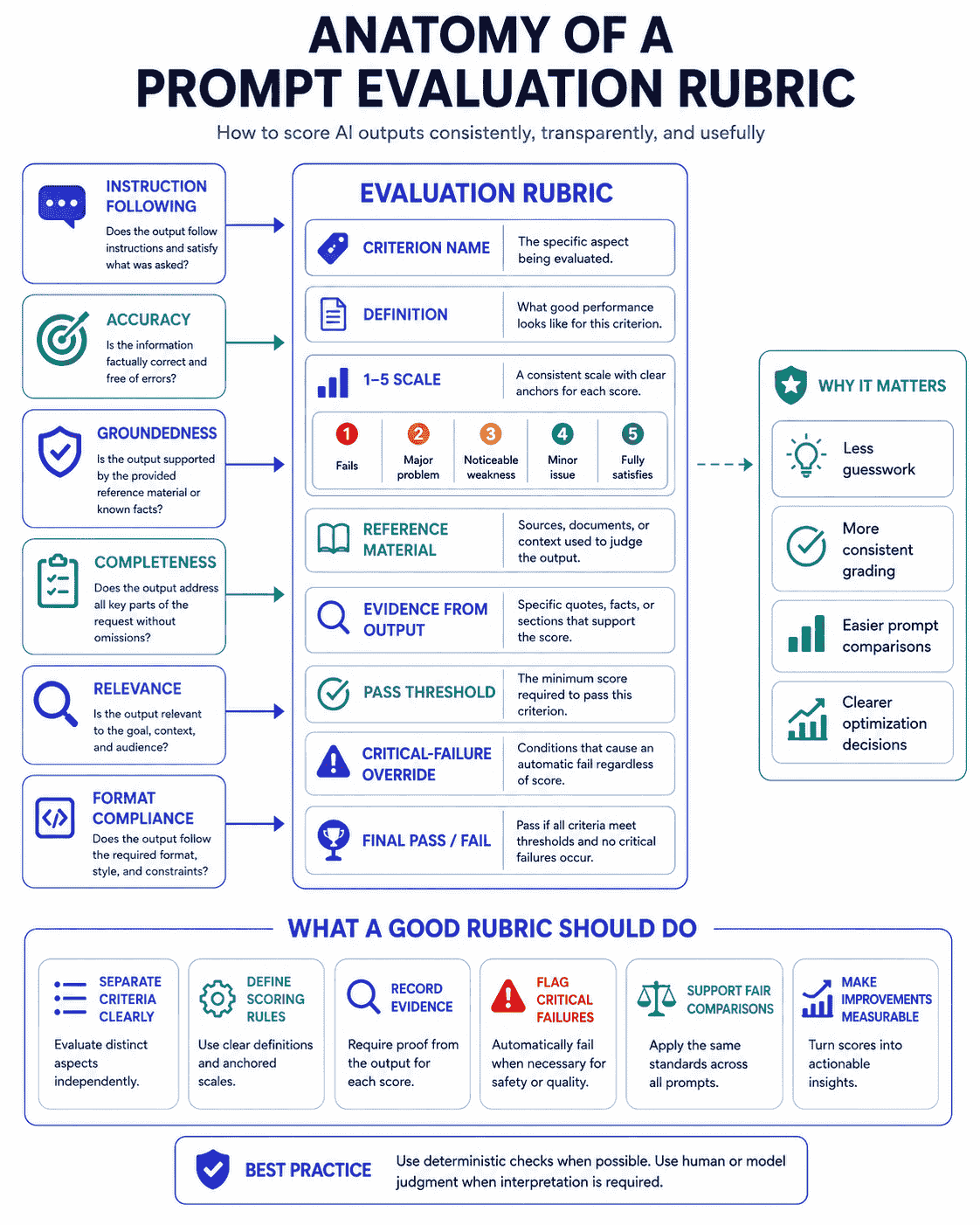
How to Build a Prompt Evaluation Rubric
A good rubric converts a vague preference into repeatable grading instructions.
Reusable Evaluation Prompt
You are evaluating an AI response against a defined task.

Evaluate the response from 1 to 5 for each criterion:

1. Instruction following
2. Factual accuracy
3. Relevance
4. Completeness
5. Output format compliance

Scoring:
5 = Fully satisfies the criterion.
4 = Minor issue that does not materially reduce usefulness.
3 = Noticeable weakness or omission.
2 = Major problem.
1 = Fails the criterion.

For each criterion:
- Return the score.
- Give a brief evidence-based explanation.
- Identify the specific requirement that was satisfied or violated.

Then return:
- Total score
- Critical failures
- Overall pass/fail
- Recommended prompt improvement

Task:
{task}

Reference material:
{reference}

Model response:
{response}
Do Not Mix Independent Requirements
Avoid one criterion such as:
"The response should be accurate, concise, professional, complete, and well formatted."If the response is accurate but too long, what score should it receive? Separate requirements so failures remain diagnosable.
Add Critical-Failure Rules
Some failures should override the average score.
Automatic FAIL if:
- the answer invents a fact not supported by the source,
- required JSON is invalid,
- the selected product category is wrong,
- generated code fails the mandatory test suite.
This prevents a response from receiving a misleadingly high average by performing well on style while failing the main task.
How to A/B Test AI Prompts
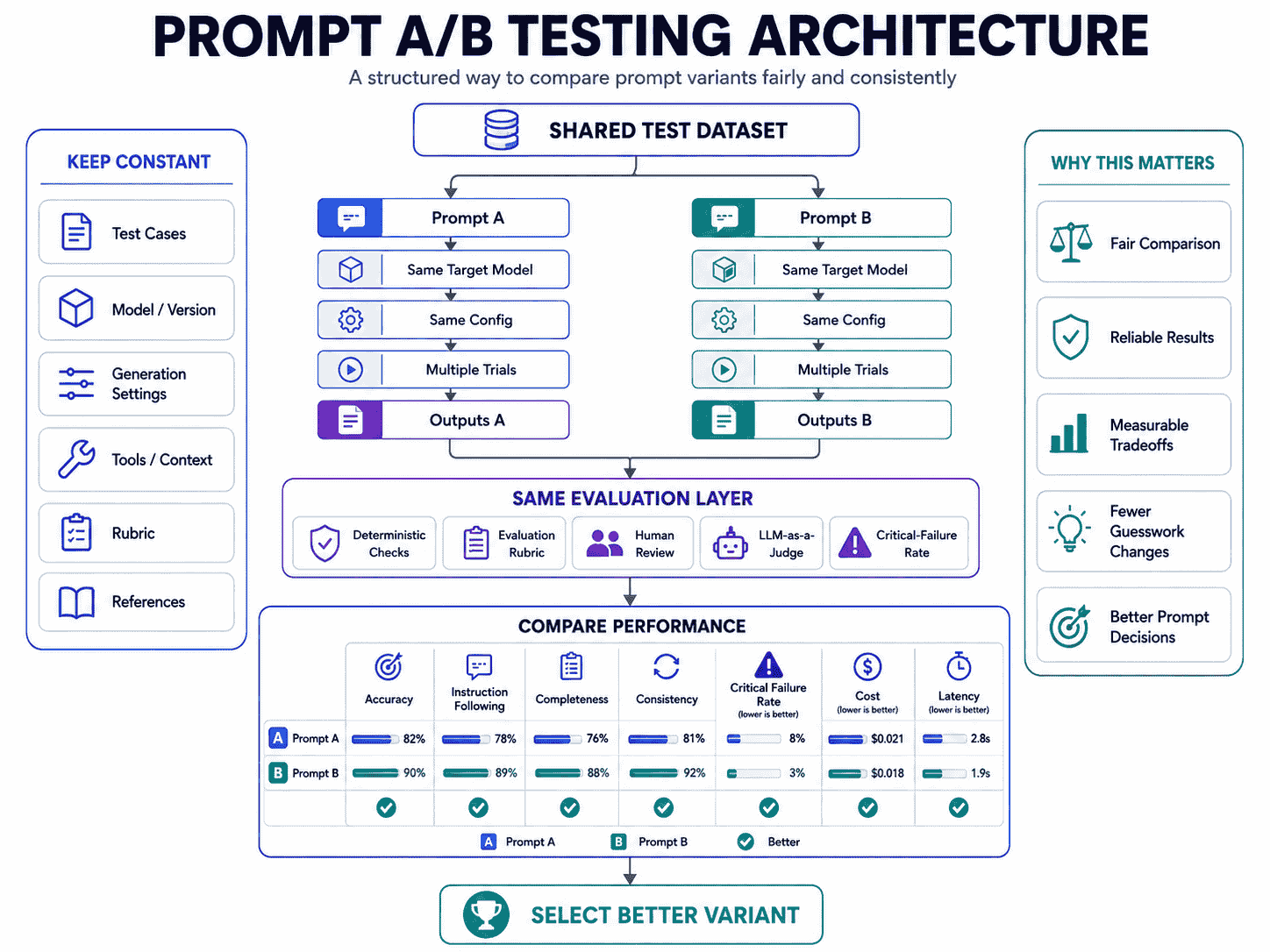
A/B testing compares two prompt variants under the same evaluation conditions.
                 Test Cases
                     │
             ┌───────┴───────┐
             ↓               ↓
          Prompt A         Prompt B
             ↓               ↓
          Outputs A        Outputs B
             └───────┬───────┘
                     ↓
              Same Evaluation
                     ↓
             Compare Performance
The Basic Rule: Change the Prompt, Not the Test
If Prompt A is tested on easy examples and Prompt B is tested on difficult examples, the comparison is meaningless.
Keep these constant when possible:
- test cases,
- target model,
- model version,
- temperature or generation configuration,
- tool access,
- system instructions outside the prompt being tested,
- evaluation rubric,
- reference answers.
Example: Minimal vs. Structured vs. Constrained
Variant A
Summarize this article.Variant B
Summarize this article in five bullet points.
Include the main argument and the strongest supporting evidence.
Variant C
Summarize this article for a non-technical reader.

Requirements:
- Maximum five bullet points
- Preserve important numbers
- Include the main argument
- Include supporting evidence
- Separate facts from opinions
- Do not introduce claims not present in the source
Test all variants on the same document set. You may discover that C improves format compliance and groundedness but slightly reduces completeness because the five-bullet limit becomes too restrictive. Evaluation reveals tradeoffs that prompt inspection alone cannot.
Evaluate Different Prompt Types Differently
A common mistake is applying the same generic rubric to every prompt. Evaluation should match the task.
Writing Prompts
- audience fit,
- tone adherence,
- structure,
- clarity,
- specificity,
- brand consistency,
- usefulness,
- constraint compliance.
Summarization Prompts
- factual consistency with the source,
- coverage of important information,
- compression,
- relevance,
- preservation of uncertainty,
- format compliance.
Classification Prompts
- label accuracy,
- precision and recall when applicable,
- handling of ambiguous inputs,
- invalid-label rate,
- consistency.
Data Extraction Prompts
- field accuracy,
- missing-value behavior,
- schema validity,
- hallucinated fields,
- exactness of numbers and dates.
Coding Prompts
- compilation or runtime success,
- test pass rate,
- requirement coverage,
- security,
- compatibility,
- maintainability when relevant.
Whenever code can be executed safely in a controlled environment, tests are generally stronger evidence than asking another model whether the code “looks correct.”
Research Prompts
- factual accuracy,
- source quality,
- citation correctness,
- claim coverage,
- clear separation of source facts and inference,
- completeness.
Image Generation Prompts
- subject adherence,
- composition,
- lighting,
- style adherence,
- color direction,
- text rendering when requested,
- brand consistency,
- unwanted visual artifacts.
RAG and Document QA Prompts
- groundedness,
- answer correctness,
- citation precision,
- refusal when evidence is missing,
- context utilization,
- relevance.
Testing Prompts Across Different AI Models
A well-structured prompt can be portable, but performance is not guaranteed to be identical across models. Models differ in instruction following, context handling, reasoning behavior, formatting reliability, tool use, and preferred prompting patterns.
                    Same Prompt
                        │
          ┌─────────────┼─────────────┐
          ↓             ↓             ↓
       Model A        Model B       Model C
          ↓             ↓             ↓
       Outputs        Outputs       Outputs
          └─────────────┬─────────────┘
                        ↓
                    Evaluation
Google explicitly positions its data-driven prompt optimizer as useful when system instructions and prompts written for one model are being moved to another model. The optimizer evaluates sample prompts and rewrites instructions for a selected target model.
When Cross-Model Evaluation Is Useful
- choosing a model for a production task,
- migrating from one provider or model version to another,
- building prompts intended to work across multiple AI tools,
- checking whether a prompt relies on model-specific behavior,
- comparing quality, latency, and cost tradeoffs.
If the prompt will be used only with one model, optimize primarily for that environment. If portability is a product requirement, include multiple models in the evaluation set rather than assuming portability.
Prompt Regression Testing
Prompt optimization can accidentally make an existing behavior worse. Regression testing protects against that.
Prompt v1
   ↓
Evaluation Set
   ↓
Baseline: 91%

Prompt v2
   ↓
Same Evaluation Set
   ↓
Result: 95%

Prompt v3
   ↓
Same Evaluation Set
   ↓
Result: 88%
Prompt v3 may look cleaner or more sophisticated, but the evaluation shows a regression.
Keep a Baseline
For each important prompt, record:
- the prompt version,
- model and relevant configuration,
- evaluation dataset version,
- grader or rubric version,
- aggregate score,
- critical failure rate,
- important per-category scores,
- cost and latency if they matter.
Add Real Failures to the Test Set
When a user finds a failure that matters, reproduce it and add it to the evaluation dataset. Then future prompt changes must continue to pass that case. Over time, this turns production mistakes into regression protection.
Building a Prompt Evaluation Dataset
An evaluation dataset is a collection of inputs and, where useful, expected answers, references, labels, rubrics, or grader metadata.
Simple Structure
{
  "id": "support-017",
  "input": "I can't log in and I was charged twice.",
  "expected": {
    "primary_category": "billing",
    "secondary_category": "account"
  },
  "rubric": [
    "Identifies the billing issue",
    "Does not ignore the account-access issue",
    "Uses only allowed labels"
  ],
  "tags": ["multiple-issues", "edge-case"]
}
Useful Dataset Fields
- unique test-case ID,
- input,
- reference context,
- expected answer or label when available,
- rubric,
- priority or severity,
- category tags,
- source of the test case,
- notes about known failure modes.
Do Not Overfit to the Evaluation Set
If you repeatedly rewrite the prompt to solve the exact wording of a small fixed test set, you can optimize for the benchmark instead of the underlying task.
Reduce this risk by:
- using diverse examples,
- keeping a separate validation set when the workflow is important,
- adding new real-world cases over time,
- checking whether improvements generalize across categories,
- avoiding prompt rules that exist only to patch one artificial test.
Practical Prompt Evaluation Examples
1. Summarization Prompt
Goal: Produce a concise executive summary without changing factual meaning.
Test set: Short article, long report, data-heavy article, opinion piece, document with conflicting claims.
Grades: Groundedness, key-point coverage, number preservation, conciseness, format compliance.
2. Marketing Copy Prompt
Goal: Produce product copy for a defined audience and brand voice.
Test set: Different product types, benefit density, technical complexity, audience sophistication.
Grades: Message clarity, audience fit, specificity, unsupported claims, CTA quality, tone.
3. Customer-Support Reply Prompt
Goal: Answer accurately while following policy.
Test set: Clear question, angry customer, ambiguous request, refund request, unsupported action, multiple issues.
Grades: Policy compliance, correctness, helpfulness, tone, escalation behavior.
4. Classification Prompt
Goal: Assign the correct label.
Test set: Balanced samples across labels plus ambiguous and multi-intent cases.
Grades: Accuracy, per-label recall, invalid label rate, consistency.
5. Structured JSON Prompt
Goal: Extract fields into machine-readable output.
Test set: Complete data, missing data, reordered text, irrelevant text, conflicting fields.
Grades: JSON parse success, schema compliance, field accuracy, hallucinated values.
6. Coding Prompt
Goal: Implement a function that satisfies documented behavior.
Test set: Standard cases, boundary cases, invalid input, performance case.
Grades: Unit tests, static checks, requirement coverage, security review where relevant.
7. Code Review Prompt
Goal: Find real defects without flooding the user with speculative warnings.
Test set: Known-bug patches, clean patches, security issue, performance issue, misleading but correct code.
Grades: Finding precision, finding recall, severity accuracy, evidence quality, false-positive rate.
8. Research Prompt
Goal: Produce an evidence-based answer.
Test set: Well-documented topic, conflicting sources, recent topic, sparse evidence, misleading premise.
Grades: Factuality, source quality, citation coverage, uncertainty handling, synthesis.
9. Translation Prompt
Goal: Preserve meaning while matching locale and audience.
Test set: Formal text, informal text, idioms, product UI, technical terminology.
Grades: Meaning preservation, terminology, fluency, register, formatting.
10. Image Prompt
Goal: Generate a consistent product hero image.
Test set: Different products while holding composition rules constant.
Grades: Subject accuracy, composition, lighting, brand colors, unwanted text, visual artifacts.
11. RAG Answer Prompt
Goal: Answer only from retrieved context.
Test set: Answer present, partially present, absent, contradictory context, distractor passages.
Grades: Groundedness, correctness, citation precision, appropriate “insufficient evidence” behavior.
12. Brainstorming Prompt
Goal: Produce a useful range of ideas rather than near-duplicates.
Test set: Several topics with different constraints.
Grades: Diversity, relevance, feasibility, novelty, constraint adherence.
How to Use LLM-as-a-Judge Carefully
LLM-based grading is useful because many important qualities cannot be checked with exact-match logic. However, an AI judge is itself a model with failure modes.
Research on LLM-as-a-judge has repeatedly found sensitivity to evaluation design, bias, and task type. Recent 2026 work continues to study instability in long-form judging and sensitivity to semantically equivalent judge prompts. Treat model-based grading as a measurement instrument that requires validation, not as unquestionable ground truth.
Prefer Deterministic Checks First
If JSON can be parsed, parse it. If code can be tested, test it. If a label has a reference answer, compare it directly. Reserve LLM judges for properties that require interpretation.
Give the Judge a Specific Rubric
Bad:
Is this a good answer?Better:
Score factual consistency from 1–5.

Use only the supplied reference text.
Penalize any unsupported factual claim.
Do not reward writing style.
Return:
- score,
- unsupported claims,
- missing critical facts,
- short justification.
Use Reference Material When Possible
A judge cannot reliably evaluate factual correctness if it does not have access to the information required to determine correctness.
Separate Criteria
Do not ask one model to blend accuracy, tone, conciseness, style, and completeness into an undefined “quality” score. Score dimensions independently.
Test the Judge Against Human Labels
Take a sample of outputs, have qualified humans evaluate them, and compare the judge's decisions. Investigate systematic disagreements before trusting the grader at scale.
Reduce Position Bias in Pairwise Evaluation
If comparing A and B, randomize which response appears first. For high-value evaluations, consider evaluating both orderings and checking whether the decision changes.
Watch for Prompt Injection in Evaluated Content
If the evaluated response can contain untrusted text, make sure the judge treats that text as content to evaluate rather than instructions to follow. This is especially important for automated evaluation pipelines processing user-controlled material.
Quality Is Not the Only Metric
A prompt can improve answer quality while making the workflow too slow or expensive. Anthropic includes latency and price among possible success criteria, which is a useful reminder that production prompt quality is multidimensional.
Example Tradeoff
| Prompt | Quality | Format Pass Rate | Average Output Tokens | Latency |
|---|---|---|---|---|
| A | 84 | 91% | 410 | 1.8s |
| B | 88 | 98% | 760 | 3.4s |
Prompt B has better quality and format compliance, but it is longer and slower. Whether B is “better” depends on the application. For a high-value research report, the tradeoff may be worthwhile. For a high-volume autocomplete feature, it may not be.
Evaluate the Whole Requirement
Quality score
Critical failure rate
Consistency
Latency
Input tokens
Output tokens
Estimated cost per task
Common Prompt Evaluation Mistakes
1. Testing Only One Example
One successful output is a demo, not an evaluation.
2. Judging the Prompt Instead of the Output
A prompt can be beautifully written and still fail the task.
3. Using Vague Criteria
“High quality” or “professional” is difficult to reproduce without definitions.
4. Testing Only Easy Cases
Prompts often fail on ambiguity, missing information, unusual formatting, multiple intents, or long inputs.
5. Evaluating Only the Best Run
Cherry-picking a good completion hides instability.
6. Changing Multiple Variables at Once
If you change the prompt, model, temperature, and test set simultaneously, you cannot tell what caused the difference.
7. Using an LLM Judge for Everything
Prefer deterministic tests when they are available.
8. Trusting the Judge Without Validating It
A grader that disagrees systematically with humans can optimize your prompts in the wrong direction.
9. Ignoring Model Changes
A prompt validated on one model version may behave differently after a model change. Re-run important evals during migrations.
10. Ignoring Cost and Latency
More instructions and longer outputs can improve one quality metric while reducing product efficiency.
11. Overfitting to the Test Set
Do not turn the prompt into a collection of patches for a small benchmark.
12. Failing to Preserve a Baseline
Without a previous score and versioned test set, you cannot reliably detect regressions.
13. Mixing Prompt Failure With Model or System Failure
Not every bad output is best fixed by rewriting the prompt. The cause may be missing context, retrieval quality, tool failure, model capability, bad data, or an unrealistic requirement.
A Practical Prompt Evaluation Workflow
You can start with a lightweight process and make it more rigorous as the prompt becomes more important.
Step 1: Define the Task
Write one sentence describing what the prompt must accomplish.
Step 2: Define Success Criteria
Separate critical requirements from preferences. Choose measurable dimensions.
Step 3: Create a Baseline Prompt
Use the current prompt as v1. Do not optimize it before you have a baseline unless you have no existing prompt.
Step 4: Build Representative Test Cases
Include normal, difficult, and edge cases.
Step 5: Choose Grading Methods
Use exact match, code, rules, rubrics, humans, or LLM judges depending on the criterion.
Step 6: Run the Baseline
Record results by test case and criterion. Use repeated trials where variability matters.
Step 7: Diagnose Failure Patterns
Do not immediately add more words. Ask which requirement is failing and why.
Step 8: Create One or More Prompt Variants
Change the instructions in a way that targets the measured weakness.
Step 9: Re-run the Same Evaluation
Compare variants under equivalent conditions.
Step 10: Inspect Tradeoffs
Check whether one metric improved while another regressed.
Step 11: Select and Version the Winner
Save the prompt, dataset version, grader version, and scores.
Step 12: Add Future Failures as Regression Tests
Every important real-world failure can make the evaluation suite stronger.
Define Goal
   ↓
Define Success Criteria
   ↓
Build Test Cases
   ↓
Run Baseline
   ↓
Grade Outputs
   ↓
Find Failure Pattern
   ↓
Analyze / Optimize Prompt
   ↓
Run Same Evaluation
   ↓
Compare
   ↓
Better? ── No → Revise or Revert
   │
  Yes
   ↓
Save as New Baseline
   ↓
Monitor and Add Regression Cases
Where PrompTessor Fits in Prompt Evaluation
Prompt evaluation and prompt optimization are connected, but they are not the same thing. Evaluation measures whether a prompt performs well on a task. Prompt analysis and optimization help improve the prompt itself.
PrompTessor is an AI prompt workspace for generating, analyzing, optimizing, refining, reverse-engineering, saving, and reusing prompts. Its Prompt Analysis workflow evaluates prompt-level qualities such as clarity, specificity, context, goal orientation, structure, and constraints, then its optimization and refinement workflows can help turn identified weaknesses into stronger prompt variants.
Analyze Prompt-Level Weaknesses Before Creating a New Variant
Evaluation may reveal that a prompt performs poorly, but the score alone does not always explain why. Prompt analysis can help inspect the instruction itself for issues such as unclear goals, missing context, weak constraints, or insufficient specificity.
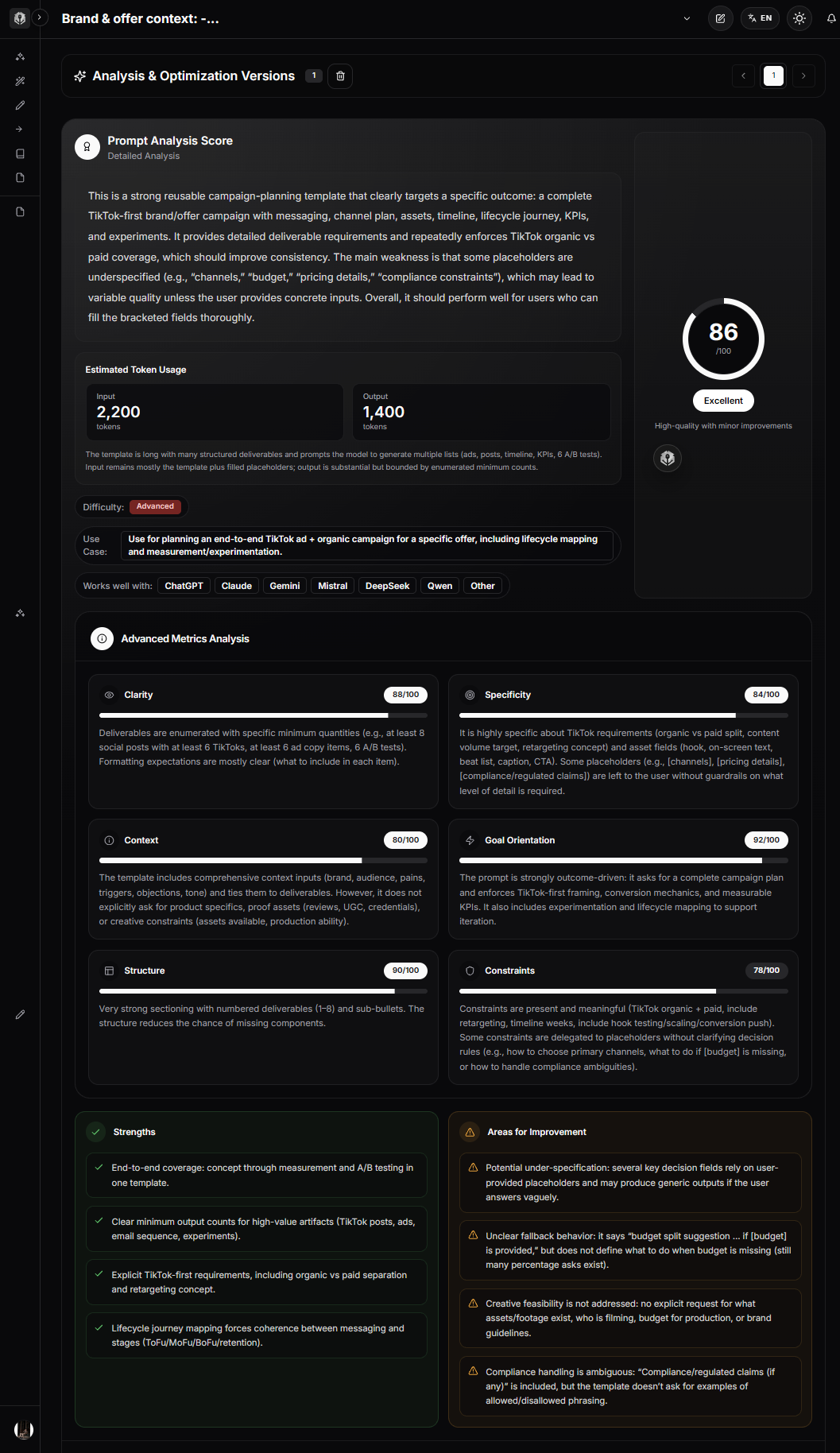
PrompTessor analyzes prompt-level factors such as clarity, specificity, context, goals, structure, and constraints, helping identify areas that may be worth improving before creating and testing another variant.
A Practical Combined Workflow
Original Prompt
      ↓
Prompt Evaluation Baseline
      ↓
Identify Failing Criteria
      ↓
PrompTessor Prompt Analysis
      ↓
Find Prompt-Level Weaknesses
      ↓
Optimize or Refine Prompt
      ↓
New Prompt Variant
      ↓
Run the Same Evaluation
      ↓
Compare With Baseline
This distinction matters. PrompTessor should not replace task-specific validation such as unit tests, factual verification, human review, or application-specific eval datasets. Instead, it can support the part of the loop where you need to understand and improve the prompt that produced the behavior.
If you want to learn more about the prompt side of this workflow, see:
- What Is Prompt Engineering? How to Write Better AI Prompts
- 10 AI Prompt Examples and Techniques for Better AI Outputs
- Prompt Engineering Best Practices
- AI Prompt Templates for ChatGPT, Claude, Gemini, and More
Prompt Evaluation Checklist
Before calling a prompt “better,” check the following.
- Is the task clearly defined?
- Are the success criteria measurable?
- Do the metrics match the real user outcome?
- Does the test set include common cases?
- Does it include difficult and edge cases?
- Are important historical failures represented?
- Are deterministic checks used where possible?
- Are subjective criteria defined with a rubric?
- Has any LLM judge been checked against human judgment?
- Are prompt variants tested on the same data?
- Is the target model configuration held constant during comparison?
- Are multiple trials used when output variability matters?
- Are critical failures tracked separately from average score?
- Are cost and latency evaluated when relevant?
- Is there a saved baseline?
- Can future prompt changes be regression-tested?
- Is the prompt evaluated on the model where it will be deployed?
- Are you fixing a prompt problem rather than a retrieval, tool, data, or model problem?
Official Resources
- Anthropic: Define success criteria and build evaluations
- Anthropic: Demystifying evals for AI agents
- OpenAI: Working with evals
- OpenAI: Graders
- Google Cloud: Data-driven prompt optimizer
- Google Cloud: Few-shot prompt optimizer
Note: OpenAI's legacy Evals platform and the dataset-backed prompt optimizer are currently on a published deprecation path. OpenAI's documentation states that Evals is scheduled to become read-only for existing users on October 31, 2026 and shut down on November 30, 2026. The evaluation principles in this article are platform-independent; check the current OpenAI documentation before implementing platform-specific tooling.
FAQ About AI Prompt Evaluation
What is AI prompt evaluation?
AI prompt evaluation is the process of testing a prompt on representative inputs and measuring whether its outputs satisfy defined success criteria.
How do you evaluate the quality of an AI prompt?
Define the expected behavior, create representative test cases, run the prompt, grade the outputs with appropriate checks or rubrics, and compare the results against a baseline or alternative prompt.
Is prompt evaluation the same as prompt analysis?
No. Prompt analysis examines qualities of the prompt itself, such as clarity, context, specificity, structure, and constraints. Prompt evaluation measures the behavior produced by the prompt on actual test cases.
What is the difference between prompt evaluation and prompt optimization?
Evaluation measures performance. Optimization changes the prompt in an attempt to improve that performance. A strong workflow evaluates before and after optimization.
What metrics should be used for prompt evaluation?
Metrics depend on the task. Common dimensions include instruction following, accuracy, groundedness, completeness, relevance, format compliance, consistency, tone, latency, and cost.
How many test cases do I need?
There is no universal number. Start with enough cases to represent common inputs, difficult inputs, and important edge cases. Even a carefully selected small set is better than relying on one example, then expand it with real-world failures.
Should I run the same prompt more than once?
Yes when output variability can affect the result. Repeated trials help distinguish consistently good performance from a lucky completion.
What is prompt A/B testing?
Prompt A/B testing compares two prompt variants on the same test cases using the same model configuration and evaluation criteria.
What is a prompt evaluation rubric?
A rubric defines the criteria used to grade outputs and explains what different score levels mean. It makes subjective evaluation more consistent and diagnosable.
Can an AI evaluate another AI response?
Yes. This is commonly called LLM-as-a-judge. It is useful for scalable evaluation of qualitative dimensions, but the judge should be validated because model-based graders can be biased or inconsistent.
Should I use an LLM judge for every evaluation?
No. Use deterministic checks when possible. Parsing JSON, comparing known labels, running code tests, or checking exact constraints is usually more reliable than asking a model to judge them.
Can a shorter prompt outperform a longer prompt?
Yes. More instructions do not automatically improve output quality. A shorter prompt that communicates the task clearly can outperform a longer prompt containing redundant or conflicting instructions.
Can a prompt perform differently across AI models?
Yes. Models differ in instruction following, reasoning, formatting, context use, and other behaviors. Evaluate prompts on the models where they will actually be used.
What is prompt regression testing?
Prompt regression testing means rerunning a saved evaluation suite after a prompt change to verify that existing behavior did not get worse.
What should be included in a prompt evaluation dataset?
Typical fields include the input, reference context, expected answer or label when available, rubric, category tags, severity, and notes about known failure modes.
How do I evaluate a writing prompt?
Evaluate dimensions such as audience fit, tone, clarity, structure, specificity, usefulness, and compliance with required constraints.
How do I evaluate a coding prompt?
Prefer executable evidence such as compilation, unit tests, integration tests, static checks, and requirement coverage. Add model or human review for qualities that cannot be validated automatically.
How do I evaluate an image prompt?
Use criteria such as subject adherence, composition, style, lighting, color direction, text rendering, brand consistency, and visual artifacts. Because generation can vary, repeated trials are often useful.
How do I evaluate a RAG prompt?
Common dimensions include groundedness, answer correctness, citation precision, context utilization, relevance, and the ability to say that evidence is insufficient when the answer is not supported by retrieved context.
What is a critical-failure rule?
A critical-failure rule marks an output as failed regardless of its average score when a non-negotiable requirement is violated, such as invalid JSON, an unsupported factual claim, the wrong classification label, or failing mandatory tests.
Should prompt evaluation include cost and latency?
Yes when they affect the real application. A small quality improvement may not justify substantially higher response time or inference cost in a high-volume workflow.
Can prompt evaluation prevent hallucinations?
Evaluation cannot guarantee that hallucinations never occur, but it can measure groundedness and unsupported-claim rates, expose failure patterns, and verify whether prompt changes reduce those failures.
When should I update the evaluation set?
Update it when the task changes, a new model is adopted, a meaningful real-world failure appears, or the current dataset no longer represents the inputs the prompt receives.
Can PrompTessor run a full application-specific eval suite?
PrompTessor focuses on the prompt workflow: generating, analyzing, optimizing, refining, reverse-engineering, saving, and reusing prompts. Application-specific evaluation may still require external test datasets, programmatic graders, human review, factual validation, or domain-specific tests.
How can PrompTessor help after an evaluation finds a weak prompt?
You can use Prompt Analysis to inspect prompt-level qualities such as clarity, specificity, context, goals, structure, and constraints, then create an optimized or refined version and run the same external evaluation again to measure whether performance improved.
Conclusion
Better prompting should not be a contest to write the longest or most sophisticated instruction. A prompt is useful when it reliably produces the behavior your workflow requires.
The practical path is straightforward: define success, build representative test cases, grade outputs with the simplest reliable method, compare prompt variants under equivalent conditions, measure variability and tradeoffs, then optimize based on evidence rather than intuition.
As a prompt becomes more important, turn successful tests and real-world failures into a regression suite. That transforms prompting from one-off experimentation into a repeatable improvement process.
Prompt analysis can help identify what may be weak in the instruction. Prompt evaluation shows what actually happens. Prompt optimization changes the instruction. The strongest workflow connects all three and keeps testing after every meaningful change.
Build better prompts in one workspace
Generate prompts from ideas, analyze and optimize quality, refine with feedback, reverse-engineer content, and save reusable prompts in your Prompt Library.
Try PrompTessor Free